Have you ever wanted stronger, more defined arms but felt held back by not having a gym membership or expensive equipment? You’re not alone. Thousands of people are discovering that you can achieve impressive arm strength and tone through at home arm workout no weights routines that use nothing but your own bodyweight. Whether you’re a busy professional, a stay-at-home parent, or simply someone who prefers exercising in the comfort of your own space, bodyweight arm exercises offer a convenient and highly effective solution.
In this comprehensive guide, you’ll discover ten powerful arm exercises that require zero equipment, learn proper form techniques to maximize results, and understand how to structure these movements into a complete workout routine. Let’s transform your arms using the most accessible gym equipment available—your own body.
Why Bodyweight Arm Workouts Are Just as Effective as Weights
Many fitness enthusiasts mistakenly believe that building arm strength requires dumbbells, barbells, or resistance machines. The truth is that bodyweight exercises engage multiple muscle groups simultaneously, improve functional strength, and can be just as challenging as traditional weighted exercises when performed correctly.
Key benefits of no equipment arm workouts include:
- Convenience: Exercise anywhere, anytime without depending on gym hours or equipment availability
- Cost-effective: Zero investment needed beyond comfortable workout clothes
- Injury prevention: Lower risk of dropping weights or using improper loads
- Functional strength: Movements that translate to real-world activities
- Scalability: Easy to modify for any fitness level from beginner to advanced
Research published in the Journal of Strength and Conditioning Research confirms that bodyweight training produces significant improvements in muscular endurance and strength, particularly in the upper body when exercises are performed with proper form and progressive difficulty.
Understanding Your Arm Muscles
Before diving into the exercises, it’s helpful to understand which muscles you’re targeting during your arm toning exercises without dumbbells. Your arms consist of several key muscle groups:
Biceps: Located on the front of your upper arm, responsible for pulling and curling movements
Triceps: Found on the back of your upper arm, making up about two-thirds of your arm mass, responsible for pushing and extending
Forearms: Multiple smaller muscles that control wrist and finger movements while providing grip strength
Shoulders (Deltoids): While technically not part of the arm, these muscles heavily influence arm appearance and function
Most bodyweight arm exercises engage multiple muscle groups simultaneously, providing comprehensive upper body development rather than isolating individual muscles.
10 Best Bodyweight Arm Exercises for Beginners
1. Standard Push-Ups
The classic push-up remains one of the most effective upper body workout without weights movements available. This exercise primarily targets your triceps, chest, and shoulders while engaging your core for stability.
How to perform:
- Start in a plank position with hands slightly wider than shoulder-width
- Keep your body in a straight line from head to heels
- Lower your chest toward the ground by bending your elbows
- Push back up to the starting position
- Perform 8-12 repetitions
Beginner modification: Perform push-ups with knees on the ground while maintaining a straight line from knees to shoulders.
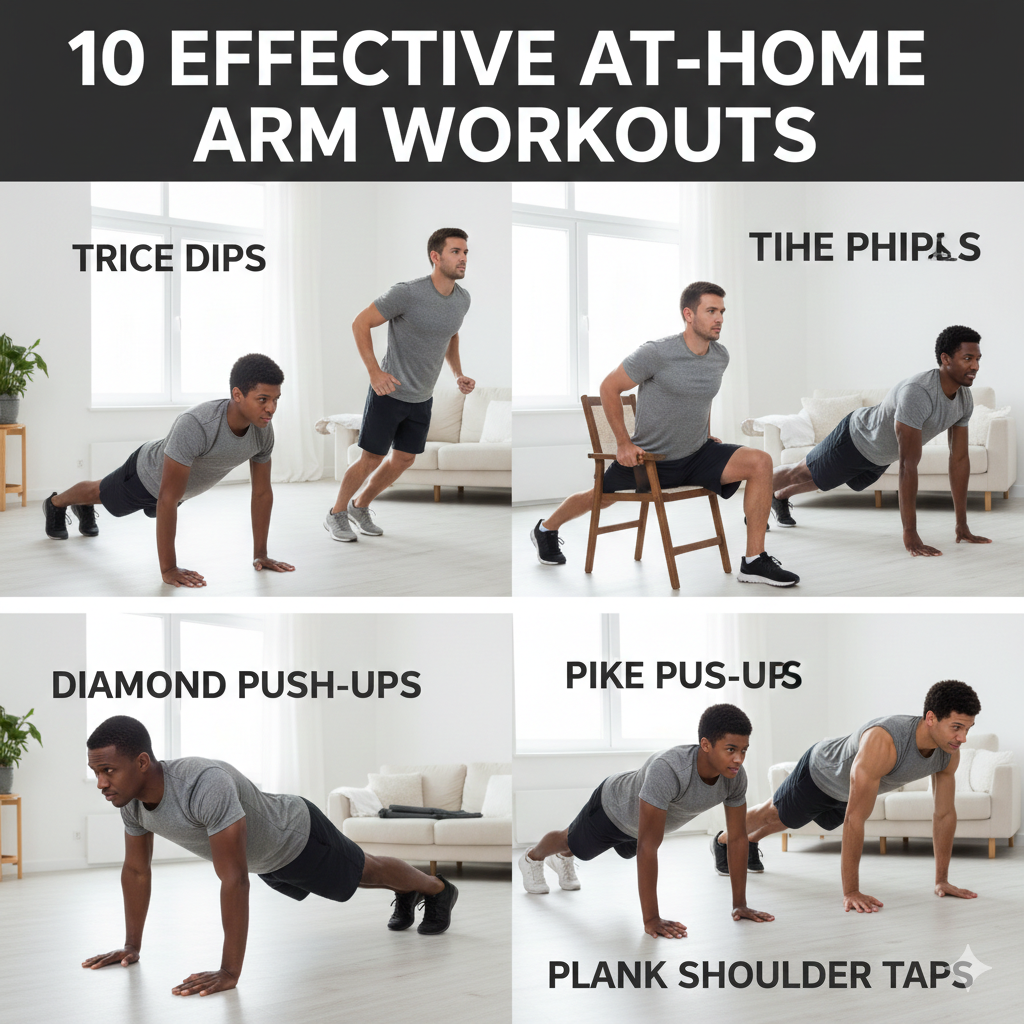
2. Tricep Dips
Tricep dips are exceptional for targeting the back of your arms, the area many people want to tone and strengthen.
How to perform:
- Sit on the edge of a sturdy chair or bench
- Place hands on the edge beside your hips, fingers pointing forward
- Slide your bottom off the edge, supporting yourself with your arms
- Lower your body by bending your elbows to about 90 degrees
- Push back up to straighten your arms
- Complete 10-15 repetitions
Progression tip: Extend your legs straighter to increase difficulty, or bend knees more to make it easier.
3. Diamond Push-Ups
This variation shifts more emphasis to your triceps compared to standard push-ups, making it perfect for building arm definition.
How to perform:
- Start in push-up position but bring hands together to form a diamond shape with index fingers and thumbs
- Keep elbows close to your body as you lower down
- Push back up maintaining the diamond hand position
- Aim for 6-10 repetitions
4. Plank Shoulder Taps
This plank arm workout at home combines core stability with arm strengthening through controlled movement.
How to perform:
- Begin in a standard plank position on your hands
- Keeping hips stable, lift your right hand and tap your left shoulder
- Return right hand to the ground
- Repeat with left hand tapping right shoulder
- Continue alternating for 20-30 total taps
Form focus: Minimize hip rotation by engaging your core throughout the movement.
5. Pike Push-Ups
Pike push-ups emphasize shoulder strength while still engaging your triceps, offering excellent upper arm development.
How to perform:
- Start in downward dog position with hips high and hands shoulder-width apart
- Bend your elbows to lower the top of your head toward the ground
- Keep your back relatively straight
- Push back up to starting position
- Complete 8-12 repetitions
6. Arm Circles
While simple, arm circles provide excellent shoulder engagement and muscular endurance when performed with proper intensity.
How to perform:
- Stand with arms extended straight out to the sides at shoulder height
- Make small circles forward for 30 seconds
- Reverse direction for another 30 seconds
- Rest and repeat 2-3 times
Intensity tip: Slow, controlled circles with arms fully extended create significant burn in shoulders and arms.
7. Inchworms
This dynamic movement works your entire upper body while improving flexibility and coordination.
How to perform:
- Start standing, then bend forward and place hands on the ground
- Walk hands forward until you reach a plank position
- Perform one push-up (optional)
- Walk hands back toward feet and stand up
- Repeat for 6-8 repetitions
8. Plank to Downward Dog
This flowing movement builds shoulder and arm strength while stretching your posterior chain.
How to perform:
- Begin in a forearm plank position
- Push your hips up and back into downward dog position
- Hold for 2-3 seconds
- Return to plank position
- Complete 10-12 repetitions
9. Pseudo Planche Push-Ups
For more advanced practitioners, this variation creates intense arm and shoulder engagement.
How to perform:
- Start in push-up position but place hands slightly below chest level
- Lean forward so shoulders move past your hands
- Lower down while maintaining this forward lean
- Push back up
- Perform 5-8 repetitions
10. Wall Walks
This challenging exercise builds tremendous shoulder and arm strength while improving body control.
How to perform:
- Start in push-up position with feet against a wall
- Walk feet up the wall while walking hands closer to the wall
- Go as high as comfortable
- Walk back down in a controlled manner
- Complete 3-5 repetitions
Creating Your Quick Arm Workout Without Weights
Now that you know the exercises, here’s how to structure an effective 20 minute no weights arm workout routine:
Beginner Routine (15-20 minutes):
- Warm-up: Arm circles and shoulder rolls (3 minutes)
- Standard push-ups: 3 sets of 8-10 reps
- Tricep dips: 3 sets of 10-12 reps
- Plank shoulder taps: 3 sets of 20 taps
- Inchworms: 2 sets of 6 reps
- Cool-down stretches (3 minutes)
Intermediate Routine (20-25 minutes):
- Warm-up (3 minutes)
- Diamond push-ups: 3 sets of 8-10 reps
- Pike push-ups: 3 sets of 10 reps
- Tricep dips: 3 sets of 12-15 reps
- Plank to downward dog: 3 sets of 12 reps
- Arm circles: 2 sets of 60 seconds
- Cool-down (3 minutes)
Advanced Routine (25-30 minutes):
- Warm-up (3 minutes)
- Pseudo planche push-ups: 4 sets of 6-8 reps
- Wall walks: 3 sets of 4-5 reps
- Diamond push-ups: 3 sets of 12-15 reps
- Pike push-ups: 3 sets of 12-15 reps
- Plank shoulder taps: 3 sets of 30 taps
- Cool-down (3 minutes)
Proper Form Tips for Maximum Results
Achieving the best bodyweight arm workout for busy schedule requires attention to technique, not just completing repetitions.
Essential form principles:
Maintain body alignment: Keep your body in straight lines during planks and push-ups—no sagging hips or raised bottoms
Controlled movement: Lower down slowly (2-3 seconds) and push up with control rather than momentum
Full range of motion: Move through the complete exercise range unless mobility limitations exist
Breathing pattern: Exhale during the exertion phase (pushing up) and inhale during the lowering phase
Elbow position: For proper push up form for arms, keep elbows at approximately 45-degree angles rather than flaring straight out
Core engagement: Tighten your abdominal muscles throughout all exercises to protect your lower back
Progressive Overload Without Weights
One common question is: “How do I continue making progress with bodyweight exercises?” The answer lies in progressive overload through several methods:
Increase repetitions: Gradually add 1-2 reps per set each week
Add sets: Progress from 2 sets to 3, then eventually 4 sets
Decrease rest periods: Shorten rest between sets from 90 seconds to 60 seconds
Tempo variations: Slow down the eccentric (lowering) phase to 4-5 seconds
Advanced variations: Progress to more challenging exercise versions
Combination movements: Link exercises together without rest (supersets or circuits)
Common Mistakes to Avoid
Even experienced exercisers sometimes develop poor habits during their at home tricep workout no equipment sessions.
Mistake 1: Incomplete range of motion – Going only halfway down during push-ups or dips reduces effectiveness
Mistake 2: Speed over control – Rushing through repetitions using momentum rather than muscle engagement
Mistake 3: Neglecting warm-ups – Jumping straight into exercises increases injury risk
Mistake 4: Inconsistent training – Working out sporadically produces minimal results compared to consistent 3-4 times weekly training
Mistake 5: Ignoring recovery – Not allowing adequate rest between sessions prevents proper muscle adaptation
Mistake 6: Poor hand placement – Incorrect hand positioning can stress wrists and reduce exercise effectiveness
Frequently Asked Questions
Can I get toned arms without dumbbells?
Absolutely. Bodyweight exercises create sufficient resistance to build muscle tone and definition when performed consistently with proper form. The key is progressive overload—gradually making exercises more challenging through increased reps, slower tempo, or advanced variations. Many people achieve impressive arm development using only bodyweight training, especially when combining it with proper nutrition.
How often should I do arm workouts without weights?
For optimal results, perform dedicated arm workouts 2-4 times per week with at least one rest day between sessions targeting the same muscle groups. Your muscles grow during recovery periods, not during the workout itself. A schedule of Monday, Wednesday, and Friday works well for most people, allowing weekend recovery.
How many reps for arm toning without weights?
For muscular endurance and toning, aim for 12-20 repetitions per set. For building strength and some size, target 6-12 repetitions with more challenging exercise variations. If you can easily complete more than 20 reps, progress to a more difficult variation rather than simply adding endless repetitions.
What are the best arm exercises without weights for beginners?
Beginners should start with standard push-ups (modified on knees if needed), tricep dips with bent knees, plank holds, and arm circles. These foundational movements build base strength while allowing you to master proper form before progressing to more advanced variations like diamond push-ups or pike push-ups.
How long until I see results from bodyweight arm exercises?
Most people notice improved strength within 2-3 weeks of consistent training. Visible muscle definition typically appears after 6-8 weeks, though this varies based on factors like body fat percentage, nutrition, genetics, and training consistency. Taking progress photos every two weeks helps you track subtle changes that might not be obvious day-to-day.
Can bodyweight exercises build arm strength for older adults?
Yes, bodyweight training is excellent for older adults as it’s low-impact, requires no equipment investment, and can be easily modified to match current fitness levels. Exercises like wall push-ups, seated tricep dips, and gentle arm circles provide safe, effective arm strengthening. Always consult with a healthcare provider before starting any new exercise program.
Do I need to do cardio along with arm workouts?
While arm-focused strength training builds muscle, adding cardiovascular exercise helps reduce overall body fat, making arm definition more visible. A balanced fitness program includes both strength training and cardio. You might do arm workouts 3 times weekly and cardio on alternate days, or combine them into circuit-style training sessions.
Nutrition Tips to Support Your Arm Workout Goals
Exercise represents only part of the equation when working toward toned, strong arms. Proper nutrition supports muscle recovery and development.
Protein intake: Consume adequate protein (0.7-1 gram per pound of bodyweight) to support muscle repair
Hydration: Drink plenty of water before, during, and after workouts to maintain performance
Caloric balance: To lose arm fat with bodyweight exercises and reveal muscle definition, maintain a slight caloric deficit while preserving protein intake
Pre-workout fuel: Eat a small meal containing carbohydrates 1-2 hours before training for energy
Post-workout recovery: Consume protein and carbohydrates within 2 hours after exercising to optimize recovery
Tracking Your Progress
Motivation stays strong when you can see measurable improvement. Track your daily arm workout without weights progress through:
- Workout journal: Record exercises, sets, reps, and how you felt
- Progress photos: Take front, side, and back photos every 2-4 weeks
- Performance metrics: Note when you can add reps, sets, or progress to harder variations
- Measurements: Track arm circumference at the same point (typically mid-bicep) monthly
- Strength benchmarks: Test maximum push-ups or plank hold time monthly
Conclusion: Your Path to Stronger Arms Starts Today
Building impressive arm strength and definition doesn’t require a gym membership, expensive equipment, or complicated routines. Through consistent practice of these proven bodyweight exercises, you can develop the strong, toned arms you desire right in your own home.
Remember that the best at home arm workout no equipment is the one you’ll actually do consistently. Start with exercises matching your current fitness level, focus on proper form over speed or quantity, and progressively challenge yourself as you grow stronger. Whether you have 10 minutes or 30 minutes available, you now have the knowledge and tools to create effective arm workouts that fit your schedule and goals.
Begin with just three workouts this week, master the fundamental movements, and watch as your arm strength transforms over the coming weeks and months. Your journey to stronger, more defined arms begins with that first push-up—so let’s get started today! Ready to get started? Clear some space, set a timer, and commit to this routine 2-3 times this week. Your legs will thank you, and you’ll be amazed at how quickly you notice improvements in strength, endurance, and muscle definition. The power to transform your lower body is literally at your feet.