You don’t need a gym, a fancy machine, or an hour of free time to build a strong, defined core. A focused 15-minute ab workout at home no equipment — done consistently — delivers real results in core strength, posture, and yes, visible definition over time.
The problem with most ab routines is that they’re either too complicated, too long, or built around equipment most people don’t own. This guide strips all of that away. What you’ll find here is a practical, beginner-friendly, scientifically grounded core workout you can do on your bedroom floor — starting right now.
Fifteen minutes. Zero equipment. Real results.
Why Core Strength Matters More Than Just Abs
Before jumping into the workout, it’s worth understanding what you’re actually training — and why it matters beyond aesthetics.
Your core is not just your six-pack muscles. It’s a complex system of muscles that includes the rectus abdominis (the “six-pack”), the transverse abdominis (your deep stabilizing layer), the obliques (side abs), and the lower back muscles. Together, these muscles support virtually every movement your body makes — from sitting at a desk to lifting groceries to running.
A strong core:
- Protects the spine and reduces lower back pain
- Improves posture and body alignment
- Enhances balance and stability in everyday movements
- Boosts athletic performance across every sport and activity
- Reduces injury risk in both exercise and daily life
This is why a quick core strengthening routine isn’t just about looking good — it’s one of the most functional things you can do for your long-term health and movement quality.
What to Know Before You Start
Form Always Beats Speed
In core training, rushing through reps is the fastest way to get zero results. Your abs are postural muscles — they respond to controlled tension, not momentum. Moving slowly and deliberately through each exercise engages far more muscle fibers than cranking out sloppy reps at full speed.
Breathing Is Part of the Exercise
This is the most overlooked element of ab training. Exhale on the effort — when you crunch up, when you drive a knee in, when you hold the hardest point of a plank. Inhale on the release. Proper breathing activates the deep transverse abdominis and dramatically increases the effectiveness of every rep.
Consistency Beats Intensity
One 15-minute session won’t transform your core. Twenty sessions over a month absolutely will. The goal is to make this routine something you actually repeat — not something so brutal you dread it and avoid it after day three.
Complete 15-Minute Ab Workout at Home No Equipment
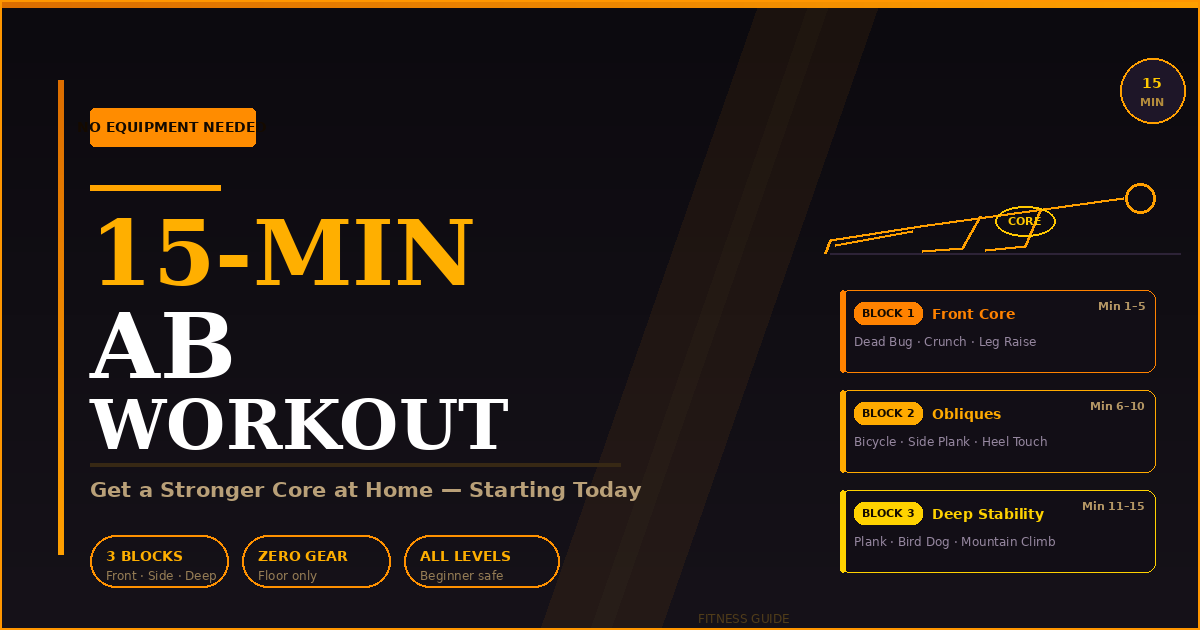
This workout is structured in three blocks of five minutes each. Each block targets a different area of the core — the front abs, the obliques, and the deep stabilizers. Rest 15–20 seconds between exercises and 45 seconds between blocks.
Block 1: Front Core Activation (Minutes 1–5)
1. Dead Bug — 45 Seconds
Lie on your back with arms extended toward the ceiling and knees bent at 90 degrees directly above your hips. Slowly lower your right arm overhead while simultaneously extending your left leg toward the floor. Return to start and switch sides. Keep your lower back pressed flat against the floor throughout.
The dead bug is one of the most effective no-equipment exercises for deep core activation. It trains the transverse abdominis — the muscle responsible for spinal stability — without any strain on the neck or lower back. It’s the perfect starting exercise for any home abs routine.
2. Crunch — 45 Seconds
Lie on your back, knees bent, feet flat. Place fingertips lightly behind your ears — not pulling on your neck. Exhale and curl your upper back off the floor until your shoulder blades clear the ground. Hold one second at the top, then lower slowly. The range of motion is short — that’s intentional. Quality over quantity.
3. Reverse Crunch — 45 Seconds
Lie on your back with hands flat beside you. Bring your knees to your chest, then use your lower abs to curl your hips off the floor — rolling your knees toward your forehead slightly. Lower slowly without letting your feet touch the ground. This targets the lower rectus abdominis, the section most traditional crunches miss entirely.
For a detailed comparison of reverse crunch vs bicycle crunch benefits, check out the supporting technique guide.
4. Straight Leg Raise — 45 Seconds
Lie flat, hands under your glutes for lower back support, legs extended. Keeping legs straight (or with a slight knee bend), raise them to 90 degrees, then lower slowly — stopping just before your heels touch the floor. This is a powerful lower ab exercise that also challenges hip flexor endurance.
Rest — 45 Seconds
Block 2: Oblique and Side Core (Minutes 6–10)
5. Bicycle Crunch — 45 Seconds
Lie on your back, knees bent, hands behind your ears. Lift your shoulder blades off the floor. Drive your right knee toward your chest while rotating your left elbow to meet it — simultaneously extending your left leg. Switch sides in a controlled, pedaling motion. Keep the movement slow and deliberate.
Bicycle crunches consistently rank among the most effective oblique exercises in research — outperforming many machine-based alternatives. They’re a cornerstone of any zero-equipment home ab workout worth following.
6. Side Plank — 30 Seconds Each Side
Lie on your right side, propped on your right forearm with elbow directly under your shoulder. Stack your feet or stagger them for balance. Lift your hips to create a straight line from head to heels. Hold and breathe. Repeat on the left side.
The side plank is the single best exercise for strengthening the obliques and quadratus lumborum — the deep side core muscles. It also builds shoulder stability and hip abductor strength as a bonus. For a breakdown of forearm plank vs side plank benefits, the plank comparison guide covers it in detail.
7. Standing Oblique Crunch — 45 Seconds Per Side
Stand with feet hip-width apart, hands behind your head. Lift your right knee toward your right elbow by crunching your right side. Lower and repeat for 45 seconds, then switch sides. This standing variation is excellent for people who find floor-based oblique exercises uncomfortable and is a great option in the ab workout plan for women at home niche.
8. Heel Touches — 45 Seconds
Lie on your back, knees bent, feet flat, arms extended at your sides. Crunch slightly to lift your shoulder blades off the floor. Reach your right hand toward your right heel, return to center, then reach your left hand toward your left heel. Alternate continuously. This isolates the obliques beautifully without any neck strain.
Rest — 45 Seconds
Block 3: Deep Stability and Plank Holds (Minutes 11–15)
9. Forearm Plank — 45 Seconds
Place your forearms on the floor with elbows under shoulders. Extend your legs behind you and lift your body into a straight line. Engage your core by drawing your belly button gently toward your spine. Don’t let your hips sag or pike upward. Breathe steadily throughout.
The forearm plank is the foundation of core stability training. Among the many plank variations for strong abs, this one builds the most comprehensive full-core endurance and is appropriate for all fitness levels.
10. Plank with Alternating Shoulder Taps — 45 Seconds
From a high plank position (hands on floor, arms extended), tap your right hand to your left shoulder, then left hand to right shoulder. Keep your hips as still as possible — resisting rotation is the entire point. This anti-rotation challenge is one of the most effective core strengthening exercises available without equipment.
11. Mountain Climber (Slow) — 45 Seconds
From a high plank, drive your right knee slowly toward your chest, return to start, then drive your left knee in. Keep your hips low and your core braced throughout. The slow version of mountain climbers maximizes core engagement compared to the fast, cardio-focused variation — making it ideal for this strength-focused block.
12. Bird Dog — 45 Seconds
Get on all fours, wrists under shoulders, knees under hips. Simultaneously extend your right arm forward and your left leg back — holding a straight line from hand to heel for 2–3 seconds. Return to start and switch sides. Like the dead bug, bird dog trains deep core stability and lower back strength without any spinal compression.
Final Hold: Forearm Plank — Max Hold
End your session with one final forearm plank held for as long as you can maintain perfect form. This is your benchmark. Track it each week — when your hold time grows, your core is getting stronger.
15-Minute Ab Workout Schedule: How Often Should You Train?
| Training Goal | Frequency | Rest Between Sessions |
| General core health | 3x per week | At least 1 day between sessions |
| Visible ab definition | 4–5x per week | Paired with full body training |
| Beginner (first 2 weeks) | 3x per week | 2 days between sessions |
| Advanced maintenance | Daily | Alternate intense and lighter days |
Core muscles recover faster than larger muscle groups like legs or back — which is why more frequent training is appropriate once you’ve built a base. However, beginners should start at 3 sessions per week and build up gradually.
Reverse Crunch vs Bicycle Crunch: Which Is Better?
Both are excellent — but they target different areas of the core. Here’s a quick comparison:
| Factor | Reverse Crunch | Bicycle Crunch |
| Primary target | Lower rectus abdominis | Obliques + upper abs |
| Difficulty | Beginner–Intermediate | Intermediate |
| Neck strain risk | Low | Low (when done correctly) |
| Equipment needed | None | None |
| Best for | Lower ab development | Full ab + oblique workout |
The answer? Do both. They complement each other perfectly — which is exactly why both appear in this routine.
Tips to See Ab Results Faster
Building a strong core through this home abs routine is straightforward. Seeing visible abs is a separate — but related — goal that requires one additional factor: body fat reduction.
Here’s the honest truth most fitness content skips:
- Ab muscles develop through consistent training — this routine handles that
- Visible abs appear when body fat drops sufficiently — that’s handled through nutrition and overall caloric balance
- You can have an incredibly strong core that isn’t visible yet — and that’s completely normal and healthy
Focus on the training. Pair it with a sensible, sustainable diet. The results will follow.
For more on how nutrition supports your core training goals, explore the cardio nutrition guide and the best foods to maximize workout gains for practical eating strategies.
FAQ: 15-Minute Ab Workout at Home No Equipment
Q: Can a 15-minute ab workout actually build a strong core? Yes — especially when the exercises are chosen strategically and performed with proper form. Fifteen focused minutes of targeted core work, done 3–4 times per week, is more than sufficient to build meaningful core strength and stability. Consistency is the multiplier that makes it work.
Q: How long before I see ab results from this routine? You’ll feel stronger within 1–2 weeks. Visible changes in muscle tone typically appear within 4–6 weeks of consistent training, depending on your starting body composition. Visible six-pack definition depends on body fat percentage and may take longer.
Q: Is this routine suitable for complete beginners? Absolutely. Every exercise in this routine is beginner-friendly. Start with shorter holds on planks, reduce reps if needed, and focus on form before volume. The dead bug and bird dog are particularly gentle starting points for true beginners.
Q: Should I do this ab workout every day? Three to four times per week is ideal for most beginners. Core muscles do recover quickly, but daily training without rest can lead to fatigue and reduced performance. As you progress, you can increase frequency gradually.
Q: What’s the best ab exercise for love handles? Oblique-focused exercises are most effective for the sides of the waist. Side planks, bicycle crunches, standing oblique crunches, and heel touches directly target the oblique muscles. For a dedicated routine, explore the quick ab exercises for love handles guide.
Q: Do I need to combine this with cardio to see results? Core training builds strength and muscle. Cardio and overall nutrition are what reduce body fat and reveal that muscle definition. Combining this routine with regular low-impact cardio — like the best low-impact cardio exercises at home — and a balanced diet gives you the complete picture.
Q: Can men and women both use this routine? Core anatomy is the same regardless of gender — so yes, this routine works equally well for everyone. The exercises, progressions, and results are universally applicable. The only difference might be starting strength levels, which the beginner-friendly structure already accounts for.
Conclusion
A 15-minute ab workout at home no equipment is one of the most accessible, effective, and time-efficient fitness habits you can build. This routine covers every region of the core — front abs, obliques, and deep stabilizers — in three focused blocks that fit into any schedule.
Show up three to four times a week. Focus on form over speed. Track your plank hold time as your weekly benchmark. And stay consistent long enough to let the results appear — because they will.
Strong abs aren’t built in a single session. They’re built one focused 15-minute block at a time.