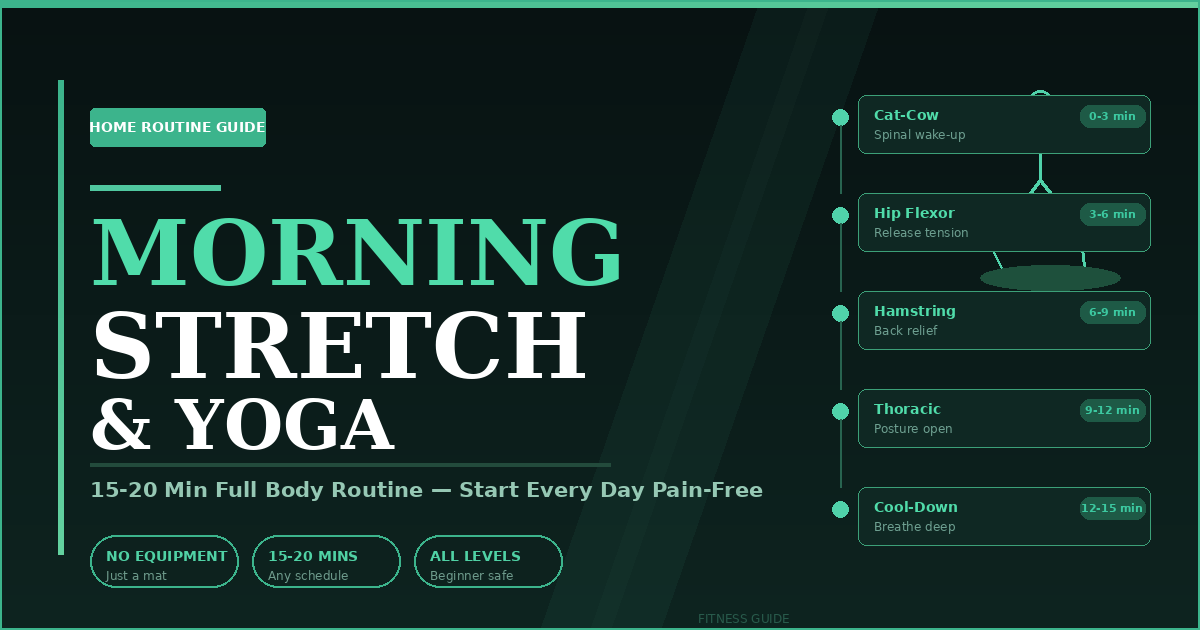
You roll out of bed, your back is stiff, your hips feel locked, and your neck is already tight — and you haven’t even had coffee yet. Sound familiar? The good news is that a simple 15 minute morning full body stretch routine at home is all it takes to completely transform how you feel before the day even starts.
No gym membership. No equipment. No hour-long commitment. Just 15 focused minutes on your mat — and your body will thank you every single day.
Why a Morning Stretch Routine Actually Matters
Most people underestimate what stretching in the morning does for the body. When you sleep, your muscles sit in a relatively fixed position for 6–9 hours. Your spinal discs compress, hip flexors tighten, and circulation slows. Jumping straight into the day without addressing this is one of the leading reasons people develop chronic lower back pain, tight hips, and poor posture over time.
A consistent morning stretch routine helps you:
- Increase blood flow to muscles and joints
- Reduce stiffness caused by overnight inactivity
- Improve spinal mobility and posture throughout the day
- Activate key muscle groups before they’re needed
- Calm the nervous system and set a positive mental tone
Research consistently shows that daily flexibility training leads to long-term improvements in range of motion, reduced injury risk, and even better sleep quality. And when you do it at home, the barrier to entry is basically zero.
What to Know Before You Start
Static vs. Dynamic Stretching in the Morning
This is one of the most common questions beginners ask — and it matters.
| Type | What It Is | Best For | Morning Use |
| Static Stretching | Holding a stretch for 20–60 seconds | Flexibility, cooling down | Yes, after light movement |
| Dynamic Stretching | Controlled movement through a range of motion | Warm-up, activation | Yes, ideal to start with |
For a morning routine, the best approach is to begin with gentle dynamic movements to warm up the joints and increase blood flow, then transition into static holds to open up the muscles more deeply. That’s exactly how this routine is structured.
How Long Should You Hold Each Stretch?
For morning routines, aim to hold static stretches for 20–30 seconds per side. This is long enough to signal the nervous system to release muscle tension without overstressing cold muscles. As your body warms up through the routine, you can extend holds slightly.
The 15 Minute Morning Full Body Stretch Routine at Home
This routine is beginner-friendly and requires only a yoga mat or soft floor space. Go through each stretch in order for the best results.
🕐 Minutes 0–3 | Spinal Wake-Up (Cat-Cow + Child’s Pose)
Cat-Cow Stretch (90 seconds)
Start on all fours with your wrists under your shoulders and knees under your hips.
- Inhale — drop your belly, lift your chest and tailbone (Cow)
- Exhale — round your spine toward the ceiling, tuck your chin (Cat)
- Move slowly and continuously for 10–12 rounds
Cat-cow is one of the best exercises for spinal mobility. It gently lubricates every vertebra and wakes up the muscles along your spine without any strain. It also doubles as a breathing exercise, which helps calm morning grogginess fast.
Child’s Pose (90 seconds)
From all fours, push your hips back toward your heels, extend your arms forward, and rest your forehead on the mat. Breathe deeply into your lower back. This passively stretches the lumbar spine, hips, and lats — all areas that tighten up overnight.
🕑 Minutes 3–6 | Hip Flexor and Glute Release
Low Lunge / Crescent Stretch (60 seconds per side)
Step your right foot forward into a lunge, lower your left knee to the floor. Sink your hips forward and downward while keeping your torso upright. Hold, then switch sides.
This is one of the most important stretches for anyone who sits for long periods. Tight hip flexors are a major driver of lower back pain and poor posture. A daily hip flexor stretch routine is one of the fastest ways to feel better in your lower back.
Figure-Four Glute Stretch (60 seconds per side)
Lie on your back, cross your right ankle over your left thigh, flex your right foot, and pull both legs toward your chest. You’ll feel a deep stretch in the outer hip and glute — exactly where piriformis tightness lives.
This is a gentler alternative to pigeon pose that works just as well for most people.
🕒 Minutes 6–9 | Hamstring and Lower Back Opening
Supine Hamstring Stretch (60 seconds per side)
Lying on your back, loop a strap, towel, or belt around your right foot. Straighten the leg toward the ceiling as much as your flexibility allows. Keep the opposite leg relaxed on the floor.
Tight hamstrings are one of the most underappreciated causes of lower back tension. Improving hamstring flexibility directly reduces the pull on your pelvis and lumbar spine.
Knees-to-Chest (30 seconds) + Lumbar Rotation (30 seconds per side)
Hug both knees to your chest and rock gently side to side. Then lower your knees to the right while keeping your shoulders flat — hold, then switch.
Lumbar rotation stretch gently decompresses the spine, releases the lower back muscles, and feels incredible after a night of sleep.
🕓 Minutes 9–12 | Upper Body and Thoracic Mobility
Thoracic Spine Extension Over Rolled Towel (60 seconds)
Roll up a towel or use a foam roller and place it horizontally under your mid-back. Let your head and hips fall toward the floor. This passively opens the thoracic spine — a region that becomes chronically rounded in people who sit at desks all day.
Thread the Needle (45 seconds per side)
On all fours, slide your right arm under your left arm along the floor, rotating your upper back. Hold and feel the thoracic rotation open up. Switch sides.
Chest Opener / Pec Stretch (30 seconds)
Clasp your hands behind your back, straighten your arms, and lift slightly while opening your chest forward. This counteracts the forward-hunched posture most of us carry throughout the day.
🕔 Minutes 12–15 | Full Body Integration and Cool-Down
Seated Forward Fold (60 seconds)
Sit with legs extended. Hinge at the hips (not the waist) and reach toward your feet. Focus on keeping a long spine rather than rounding aggressively. This stretches the entire posterior chain — hamstrings, calves, lower back, and lats — in one movement.
Standing Quad Stretch (30 seconds per side)
Stand tall, pull one foot toward your glute, and hold. Great for glute activation and quad flexibility, especially useful if you cycle or run.
Final Deep Breathing (60 seconds)
Lie flat on your back in Savasana. Take 5–6 slow, deep breaths — inhale for 4 counts, exhale for 6. This activates the parasympathetic nervous system, reduces cortisol, and leaves you feeling clear-headed and ready to move.
Tips to Make This Routine Stick
Starting a new habit is the hardest part. Here’s what actually works:
- Keep your mat out the night before so it’s waiting for you
- Pair it with something you already do — right after brushing teeth or before your morning coffee
- Start with just 3 days per week and build to daily
- Track your progress — noting when tight spots start to ease is deeply motivating
- Don’t chase pain — mild discomfort is normal; sharp pain is not
Who Benefits Most from a Morning Stretch Routine at Home?
This routine is especially effective for:
- Desk workers and remote workers dealing with hip and back stiffness
- Cyclists who need a pre-ride stretch routine or post-ride recovery
- People with lower back pain looking for non-invasive daily relief
- Beginners to yoga or flexibility training who want a structured starting point
- Busy professionals who need a quick mobility routine that actually fits their schedule
FAQ: Morning Stretch Routine at Home
Q: Is 15 minutes of stretching in the morning enough to improve flexibility? Yes — consistency beats duration every time. A focused 15-minute morning stretch routine done daily will produce noticeable flexibility improvements within 3–4 weeks. The key is doing it regularly rather than doing hour-long sessions once in a while.
Q: Should I eat before stretching in the morning? It’s generally fine to stretch on an empty stomach in the morning. Stretching isn’t intense enough to require fuel beforehand. However, drinking a glass of water first is a good idea to help hydrate your muscles and joints.
Q: Is morning or evening stretching better for flexibility? Both have benefits. Morning stretching combats overnight stiffness and sets a great tone for the day. Evening stretching helps with recovery and sleep quality. If you can only do one, morning tends to have a stronger impact on how your body feels and moves all day. For a detailed breakdown, check out our guide on morning vs evening stretching.
Q: Can this routine help with lower back pain? Absolutely. Several movements in this routine — including cat-cow, lumbar rotation, hip flexor stretches, and hamstring work — directly target the root causes of lower back tension. Many people report significant relief within 2–3 weeks of daily practice. For persistent pain, pairing this with our sciatic pain stretches or piriformis stretch guide can accelerate results.
Q: Do I need any equipment for this routine? No equipment is required. A yoga mat or soft surface is helpful for comfort. A towel or resistance band can assist with the hamstring stretch but is completely optional.
Q: How soon will I start feeling results? Most people notice reduced morning stiffness within the first week. Measurable flexibility improvements typically appear within 3–6 weeks of consistent daily practice.
Q: Can beginners do this routine? Yes — this routine is specifically designed to be beginner-friendly. Every stretch can be modified based on your current flexibility level. Never force a position; work within a comfortable range and gradually deepen each stretch over time.
Conclusion: 15 Minutes That Change Everything
A 15 minute morning full body stretch routine at home is one of the highest-return habits you can build. It costs nothing, requires no equipment, and takes less time than scrolling your phone in bed. Yet it delivers real, compounding benefits — less pain, better posture, greater mobility, and a calmer, more focused mindset to start your day.
Start with this routine three times a week, build to daily, and pay attention to how your body responds. Most people are genuinely surprised by how much better they feel in just a few weeks.
Roll out your mat tomorrow morning. Your future self will be grateful you did.
42
20 Minute Yoga Routine for Beginners at Home (No Equipment Needed)
You don’t need a fancy studio, expensive gear, or years of experience to start yoga. All you need is 20 minutes, a small patch of floor, and the willingness to show up for yourself. A 20 minute yoga routine for beginners at home is honestly one of the best places to start — it’s long enough to feel the benefits, short enough to actually do it every day.
Whether your goal is to reduce stress, improve flexibility, or simply build a healthy morning habit, this guide has everything you need to get started confidently — even if you’ve never stepped on a mat before.
Why 20 Minutes Is the Perfect Starting Point
A lot of beginners think they need hour-long sessions to see results. The truth? Consistency beats duration every single time.
A focused 20-minute daily yoga practice can deliver real, measurable benefits including improved posture, reduced anxiety, better sleep, and increased flexibility — often within the first two to three weeks. The key is showing up regularly, not perfectly.
Here’s why a short daily session works so well for beginners:
- It’s easy to fit into any schedule — before work, during lunch, or before bed
- It’s long enough to move through a complete beginner yoga sequence
- It doesn’t overwhelm your body while you’re still building foundational strength
- It creates a habit faster than occasional longer sessions
If you’ve been wondering whether 20 minutes of yoga is enough for beginners — the answer is a confident yes, especially when paired with mindful breathing and proper form.
What to Prepare Before You Begin
Setting Up Your Space
You don’t need much. Find a quiet spot with enough room to stretch your arms out wide and lie down flat. A yoga mat helps with grip and comfort, but a folded blanket or carpet works fine when you’re just starting out.
A few quick tips before your first session:
- Practice on an empty stomach or at least 1–2 hours after eating
- Wear comfortable, stretchy clothing
- Keep a glass of water nearby
- Turn off notifications — this 20 minutes is yours
Understanding Beginner Yoga Basics
Before diving into poses, it helps to understand two foundational principles: breath and alignment.
In yoga, every movement is connected to your breath. Inhaling typically opens or extends the body, while exhaling deepens a stretch or folds the body inward. Moving with your breath — rather than fighting through discomfort — is what separates yoga from ordinary stretching.
Alignment simply means positioning your body safely so you get the most benefit from each pose without risking injury. Throughout this routine, you’ll find simple alignment cues to follow.
Complete 20 Minute Yoga Routine for Beginners at Home
This routine is structured in three phases: Grounding (4 minutes), Main Flow (13 minutes), and Cool-Down (3 minutes). Move at your own pace and always listen to your body.
Phase 1: Grounding — Arrive on Your Mat (4 Minutes)
1. Easy Seated Breathing — 2 Minutes
Sit cross-legged on your mat with your hands resting on your knees. Close your eyes. Take slow, deep breaths — inhale for 4 counts, hold for 2, exhale for 6. Let your shoulders drop away from your ears.
This is your pranayama for beginners moment — simple breath awareness that calms the nervous system and brings your attention inward. Don’t rush this step. It sets the tone for everything that follows.
2. Neck and Shoulder Rolls — 1 Minute
Slowly drop your right ear to your right shoulder. Hold for a breath, then roll your chin to your chest and over to the left side. Do this gently for 30 seconds, then roll your shoulders backward in slow, wide circles for 30 seconds.
3. Cat-Cow Flow — 1 Minute
Come onto all fours with wrists under shoulders and knees under hips. Inhale as you drop your belly and lift your gaze (Cow). Exhale as you round your spine toward the ceiling and tuck your chin (Cat). Flow between the two for 8–10 breath cycles.
This simple movement warms up the spine, activates the core, and is one of the best foundational yoga poses for posture correction and back health.
Phase 2: Main Beginner Yoga Flow (13 Minutes)
4. Child’s Pose — 90 Seconds
From all fours, sit your hips back toward your heels and extend your arms forward on the mat. Rest your forehead down. Breathe deeply into your lower back and let your body fully release. This restorative cool-down yoga pose also works beautifully mid-practice whenever you need a reset.
5. Downward Facing Dog — 90 Seconds
From Child’s Pose, tuck your toes and lift your hips up and back to form an inverted V shape. Press your palms flat, keep a slight bend in your knees, and let your heels reach (not force) toward the floor. Hold and breathe for 5–8 breaths.
Downward Dog is a full-body pose — it stretches the hamstrings and calves, strengthens the arms and shoulders, and improves body alignment. It’s a cornerstone of any beginner vinyasa sequence.
6. Low Lunge (Anjaneyasana) — 60 Seconds Per Side
From Downward Dog, step your right foot forward between your hands. Lower your left knee to the mat. Sink your hips forward gently and lift your torso upright, raising your arms overhead if comfortable. Hold for 30 seconds, then switch sides.
This pose deeply stretches the hip flexors — one of the tightest muscle groups for desk workers and beginners alike. It also builds lower body strength and improves flexibility with yoga over time.
7. Warrior I — 60 Seconds Per Side
From Low Lunge, pivot your back foot flat on the mat at a 45-degree angle and straighten your back leg. Square your hips forward as much as possible. Raise both arms overhead and look up slightly. Hold for 30 seconds per side.
Warrior I is a strength-building yoga pose that targets the legs, core, and shoulders simultaneously. It also challenges your balance and focus — two things that improve quickly with a consistent short daily yoga workout.
8. Warrior II — 60 Seconds Per Side
From Warrior I, open your hips and arms out to the sides — right arm forward, left arm back, gaze over your front fingertips. Keep your front knee bent directly over your ankle. Hold for 30 seconds per side.
This pose builds tremendous leg strength and opens the hips and chest. It’s also excellent for stress relief yoga — holding a power pose while breathing deeply has a measurable calming effect on the nervous system.
9. Triangle Pose — 60 Seconds Per Side
From Warrior II, straighten your front leg. Reach your front arm long, then hinge at the hip to lower your hand toward your shin or the floor. Extend your top arm toward the ceiling and open your chest. Hold for 30 seconds per side.
Triangle pose stretches the hamstrings, inner thighs, and spine while improving overall body alignment. It’s a wonderful flexibility improvement exercise that gets easier and deeper with regular practice.
10. Seated Forward Fold — 90 Seconds
Sit with both legs extended in front of you. Inhale to lengthen your spine, then exhale and hinge forward from your hips — reaching toward your feet. Keep a soft bend in the knees if your hamstrings are tight. Hold and breathe.
Rather than forcing the stretch, focus on lengthening your spine with each inhale and softening deeper with each exhale. This is a key pose in any guided home yoga session for flexibility and stress management.
11. Bridge Pose — 90 Seconds
Lie on your back with knees bent and feet flat on the mat, hip-width apart. Press your feet into the floor and lift your hips toward the ceiling. Interlace your hands beneath your back and press your arms down. Hold for 5–8 breaths, then slowly lower down.
Bridge pose strengthens the glutes, hamstrings, and lower back while opening the chest and hip flexors. It’s one of the most effective yoga for posture correction poses you can add to your routine.
Phase 3: Cool-Down — Restore and Breathe (3 Minutes)
12. Supine Spinal Twist — 60 Seconds Per Side
Lie on your back. Draw your right knee to your chest, then guide it across your body to the left. Extend your right arm out wide and look right. Hold for 30 seconds and breathe deeply into your lower back. Repeat on the other side.
This twist releases tension through the spine and lower back — it’s deeply satisfying after a full practice and fits perfectly into any restorative cool-down yoga sequence.
13. Legs Up the Wall (or Savasana) — 90 Seconds
Either rest your legs up against a wall with your back flat on the floor, or simply lie flat in Savasana — arms by your sides, palms facing up, eyes closed. Breathe naturally and let your body fully absorb the practice.
This final stillness is not optional — it’s where the real integration happens. Your nervous system processes the session and begins to shift toward a calmer, more balanced state.
Beginner Yoga Mistakes to Avoid
Even with the best intentions, beginners often fall into a few common traps. Here’s what to watch for:
- Holding your breath — If you’re not breathing freely, you’ve gone too deep into a pose. Ease back.
- Comparing yourself to others — Even from YouTube videos. Your body is different. Your range of motion is valid.
- Skipping the warm-up — Cold muscles stretch poorly and injure easily. Never skip Phase 1.
- Forcing flexibility — Yoga improves flexibility gradually. Forcing a stretch creates tension, not release.
- Inconsistency — Three days in a row is better than one long session per week. Aim for daily practice, even if it’s just 10 minutes some days.
Yoga vs. Gym: Which Is Better for Beginners?
This is one of the most common questions new exercisers ask. Here’s a simple comparison:
| Factor | Yoga at Home | Gym Workout |
| Equipment needed | None | Often required |
| Cost | Free | Membership fees |
| Stress relief | High | Moderate |
| Flexibility gains | High | Low–Moderate |
| Strength building | Moderate | High |
| Beginner-friendly | Very | Moderate |
| Mental health benefits | Very High | Moderate |
For most beginners, yoga at home wins on accessibility, cost, and mental health impact. For those specifically focused on muscle building, combining both works well. Explore the yoga vs gym comparison guide for a deeper breakdown.
FAQ: 20 Minute Yoga for Beginners
Q: Is 20 minutes of yoga a day enough for beginners? Yes — absolutely. A consistent 20-minute daily yoga practice is enough to build flexibility, reduce stress, improve posture, and develop body awareness. The key word is daily. Short and consistent always outperforms long and occasional.
Q: How often should beginners do yoga at home? Ideally 4–6 times per week. Daily practice delivers the fastest results, but even 4 sessions per week will produce noticeable improvements in flexibility and stress levels within 3–4 weeks.
Q: Can I do this routine if I’m completely inflexible? Absolutely. This routine was designed for complete beginners. Every pose includes a modification (like soft knees in forward folds or a lower lunge instead of full splits). Inflexibility is not a barrier — it’s literally the starting point yoga works from.
Q: What is the easiest yoga flow for beginners? The easiest beginner yoga flow connects Cat-Cow, Child’s Pose, and Downward Dog in a simple loop. These three poses warm up the spine, open the hips, and stretch the entire back body without requiring any balance or strength. It’s the perfect entry point.
Q: How to start yoga at home without an instructor? Start with a structured routine like this one. Focus on breathing with movement, don’t force any pose, and use YouTube videos or beginner yoga guides for visual reference. As you build confidence, explore beginner vinyasa flow sequences and add new poses gradually.
Q: Can yoga replace gym workouts for fitness? For general fitness, stress relief, and flexibility — yes. For heavy muscle building or sport-specific conditioning — it’s better used alongside gym training. Check out the full yoga vs gym guide to decide what works best for your goals.
Q: When is the best time to do this yoga routine? Morning is ideal because yoga before work sets a calm, focused tone for the day. However, evening yoga is excellent for winding down and improving sleep quality. The best time is simply whenever you’ll actually do it consistently.
Conclusion
Starting yoga doesn’t have to be complicated or intimidating. A simple 20 minute yoga routine for beginners at home — done consistently — is one of the most powerful investments you can make in your physical and mental wellbeing.
This routine gives you everything you need: a proper warm-up, a full-body beginner flow, and a calming cool-down — all without equipment, a gym, or any prior experience. Just you, your breath, and 20 minutes.
Start today. Roll out your mat, take one deep breath, and begin. Your body will thank you within the first week.