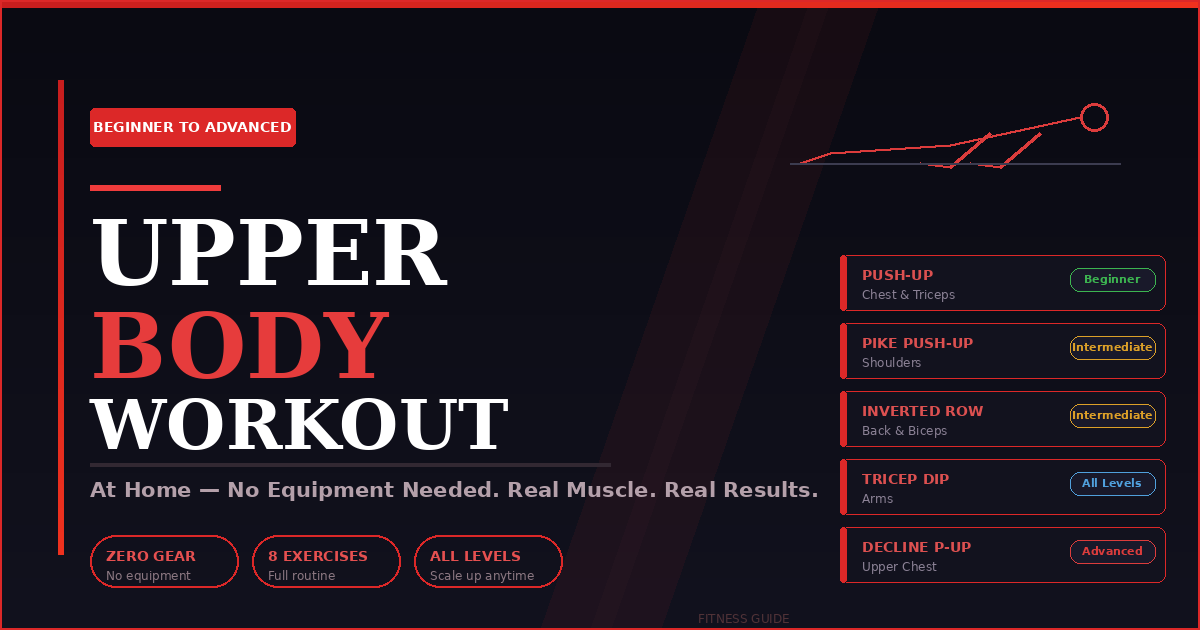
Think you need a gym membership or a rack full of dumbbells to build a strong upper body? Think again. A well-structured upper body workout at home without equipment can build real muscle, improve posture, and develop functional strength — all from your living room floor.
This guide covers everything: why bodyweight training works, the best exercises to include, a full workout routine, and how to keep making progress over time. Whether you’re a complete beginner or looking to level up your calisthenics training, there’s something here for you.
Can You Really Build Upper Body Muscle Without Weights?
This is the first question most people ask — and the answer is yes, with one condition: progressive overload.
Progressive overload means gradually increasing the difficulty of your training over time. In a gym, you do this by adding weight. At home, you do it by changing leverage, slowing down reps, reducing rest time, or moving to harder exercise variations.
Your muscles don’t know the difference between a barbell and your own bodyweight. What they respond to is tension, time under tension, and consistent challenge. Bodyweight training delivers all three when programmed correctly.
Research supports this. Studies on muscle hypertrophy without weights consistently show that compound bodyweight exercises — when taken close to failure — produce similar muscle growth to traditional weight training, especially for beginners and intermediates.
So yes — you can absolutely build upper body strength and size at home. You just need the right exercises and a smart progression plan.
Key Muscles Targeted in an Upper Body Home Workout
Before diving into the routine, it helps to know which muscles you’re training and why. A complete upper body workout at home without equipment should target:
- Chest (Pectorals) — Push-ups and their variations are the gold standard
- Shoulders (Deltoids) — Pike push-ups, lateral raises with no weight, and handstand progressions
- Triceps — Close-grip push-ups, tricep dips using a chair or floor
- Biceps — Inverted rows, towel curls, and bodyweight curl alternatives
- Upper Back (Rhomboids, Traps) — Inverted rows, Superman holds, scapular push-ups
- Core (as stabilizer) — Engaged in nearly every exercise on this list
Training all of these together creates balanced upper body strength development and prevents the common problem of overdeveloping the chest while neglecting the back and shoulders.
Best Bodyweight Upper Body Exercises (With Progressions)
Push-Up Variations for Chest and Triceps
Push-ups are the king of home chest training. The key is not just doing them — it’s progressing through variations as you get stronger.
Beginner → Intermediate → Advanced:
- Incline Push-Up — Hands elevated on a surface. Easier angle, great for beginners building foundational strength.
- Standard Push-Up — The classic. Hands shoulder-width, body in a straight line from head to heels.
- Wide Push-Up — Hands wider than shoulder-width. Increases chest activation.
- Close-Grip Push-Up — Hands close together under the chest. Shifts emphasis to triceps.
- Decline Push-Up — Feet elevated. Targets upper chest and increases overall difficulty.
- Archer Push-Up — One arm does most of the work while the other extends out. A stepping stone toward one-arm push-ups.
- One-Arm Push-Up — The advanced goal. Requires serious strength and body control.
Working through these push-up variations for chest growth is one of the most effective ways to keep progressing in a home training environment.
Pike Push-Up and Shoulder Progressions
Most beginners neglect shoulders in home workouts because they assume you need dumbbells. You don’t.
- Pike Push-Up — Form an inverted V with your hips high. Lower your head toward the floor. This targets the anterior deltoid directly.
- Elevated Pike Push-Up — Feet on a chair or couch. Increases the angle and difficulty.
- Wall Handstand Hold — Build shoulder stability and strength with a static handstand against the wall.
- Handstand Push-Up — The ultimate bodyweight shoulder exercise. Takes time to build up to, but delivers tremendous upper body strength development.
Inverted Rows for Upper Back and Biceps
This is the most underused exercise in home upper body training. All you need is a sturdy table.
Lie under a table, grip the edge, keep your body straight, and pull your chest up to the surface. Lower slowly. This is essentially a horizontal pull-up and directly targets the rhomboids, traps, rear deltoids, and biceps — the muscles most people ignore when training at home.
Progression options:
- Bent-knee inverted row — Easier, feet flat on the floor
- Straight-leg inverted row — Standard difficulty
- Feet-elevated inverted row — Advanced, increases load on upper back
Tricep Dips
Use a sturdy chair, couch edge, or low table. Place hands on the edge behind you, feet extended in front, and lower your body by bending your elbows to 90 degrees. Push back up.
This is a direct tricep isolation movement and one of the most effective no equipment muscle building exercises for arm definition.
Superman Hold and Back Extensions
Lie face down, extend your arms overhead, and simultaneously lift your arms, chest, and legs off the floor. Hold for 2–3 seconds and lower. This targets the lower traps, rhomboids, and spinal erectors — critical for posture correction and injury prevention.
Complete Upper Body Workout at Home Without Equipment
Here is a structured routine using everything above. This works as a standalone session or as part a weekly upper/lower split.
Workout Format: 3–4 rounds | Rest 45–60 seconds between exercises
| Exercise | Sets | Reps | Target |
| Standard Push-Up | 3 | 10–15 | Chest, Triceps |
| Pike Push-Up | 3 | 8–12 | Shoulders |
| Inverted Row (under table) | 3 | 8–12 | Upper Back, Biceps |
| Close-Grip Push-Up | 3 | 10–12 | Triceps |
| Decline Push-Up | 3 | 8–10 | Upper Chest |
| Tricep Dip | 3 | 10–15 | Triceps |
| Superman Hold | 3 | 10 reps (3s hold) | Upper Back, Rear Delts |
| Scapular Push-Up | 2 | 12–15 | Shoulder Stability |
This routine hits every major upper body muscle group using only your bodyweight and basic household furniture. It takes roughly 30–40 minutes with proper rest intervals.
How to Progress This Routine Over Time
This is where most home workout guides fall short — they give you a routine but never explain how to keep improving. Here’s a simple bodyweight training progression system:
Week 1–2: Master the form on each exercise. Focus on full range of motion and controlled tempo.
Week 3–4: Add one extra set per exercise. Increase reps toward the top of the listed range.
Week 5–6: Move to the next harder variation (e.g., standard push-up → decline push-up).
Week 7–8: Slow down the eccentric (lowering) phase to 3–4 seconds. This increases time under tension dramatically and drives new muscle growth.
Week 9+: Introduce more advanced variations like archer push-ups, elevated inverted rows, and eventually handstand push-up progressions.
This is how you apply progressive overload bodyweight principles without ever touching a weight. For more detail, check out the bodyweight progression techniques guide.
Bodyweight vs. Weight Training for Upper Body
Wondering how home bodyweight training stacks up against gym workouts? Here’s an honest comparison:
| Factor | Bodyweight Training | Weight Training |
| Equipment needed | None | Yes |
| Cost | Free | Gym fees or home gym |
| Muscle building potential | High (beginner–intermediate) | Very High |
| Convenience | Excellent | Moderate |
| Injury risk | Lower | Moderate |
| Progression flexibility | Moderate | Very High |
| Functional strength | High | Moderate |
For beginners and intermediates, bodyweight training delivers excellent results. Advanced trainers may eventually benefit from adding resistance bands or a pull-up bar to continue progressing. Explore the full calisthenics vs gym workout comparison for a deeper breakdown.
Tips to Get the Most Out of Your Home Upper Body Workout
Getting results from a home workout isn’t just about the exercises — it’s about how you train.
- Control your tempo. Slow, controlled reps beat fast, sloppy reps every time. A 2-second up, 3-second down tempo builds far more muscle than rushing through sets.
- Train close to failure. Leave 1–2 reps in the tank on most sets. This is what drives muscle hypertrophy without weights.
- Rest properly. 45–90 seconds between sets for muscle building. Shorter rest for conditioning.
- Stay consistent. Three to four sessions per week is ideal. More is not always better — recovery matters.
- Eat enough protein. No workout — bodyweight or otherwise — builds muscle without adequate protein. Aim for 0.7–1g per pound of bodyweight daily.
- Track your progress. Write down your reps each session. Aim to beat your previous numbers over time.
How Often Should You Train Upper Body at Home?
For most people, training upper body 2–3 times per week with at least one rest day between sessions is optimal. This allows enough frequency to stimulate muscle growth while giving your muscles time to recover and rebuild.
A simple weekly structure for home strength training routine:
- Monday: Upper Body
- Tuesday: Lower Body or Rest
- Wednesday: Upper Body
- Thursday: Rest or Cardio
- Friday: Upper Body
- Weekend: Rest or light activity
As you advance, you can split the routine into push days (chest, shoulders, triceps) and pull days (back, biceps) for more volume per muscle group. See the upper body HIIT workout guide for a conditioning-focused alternative on off days.
FAQ: Upper Body Workout at Home Without Equipment
Q: Can you build upper body muscle with just push-ups? Push-ups alone can build a strong chest and triceps, but they don’t adequately train the upper back or biceps. For balanced upper body strength development, you need to pair push-ups with pulling movements like inverted rows and Superman holds.
Q: How long does it take to see results from bodyweight upper body training? Most beginners notice increased strength and muscle definition within 3–4 weeks of consistent training. Visible muscle growth typically appears within 6–8 weeks when combined with proper nutrition and progressive overload.
Q: Is bodyweight training effective for building mass? Yes — particularly for beginners and intermediates. Studies show that bodyweight exercises taken close to failure stimulate similar muscle protein synthesis to weight training. The key is progressive difficulty, not just high repetitions.
Q: What is the best upper body workout at home for beginners? The best starting point is a simple three-exercise circuit: standard push-ups, pike push-ups, and inverted rows under a table. These three movements cover chest, shoulders, back, and arms with zero equipment. Master these before adding more complexity.
Q: Are push-ups enough for chest growth? Push-ups are highly effective for chest growth, especially when you progress through variations — wide, decline, and archer push-ups. The key is continually increasing difficulty rather than just doing more reps of the same version. Check out the push-up variations for chest guide for a complete progression roadmap.
Q: How do I train my biceps at home without weights? Inverted rows under a table are the most effective bicep exercise without equipment. Towel curls (using a towel looped around a door handle) also work well. Supinating your grip during inverted rows increases bicep activation significantly.
Q: How often should I train upper body at home to build muscle? Three times per week with proper rest between sessions is the sweet spot for most people. This provides enough training frequency to stimulate muscle growth without overtraining. Consistency over several months matters far more than session frequency.
Conclusion
Building a strong, defined upper body doesn’t require a gym, weights, or expensive equipment. A smart upper body workout at home without equipment — built around proven bodyweight exercises and consistent progression — delivers real results for beginners and experienced trainees alike.
Start with the routine in this guide, focus on form before volume, and progress through harder variations as you get stronger. Within weeks, you’ll feel the difference. Within months, you’ll see it.
Your living room is your gym. All you need to do is start.