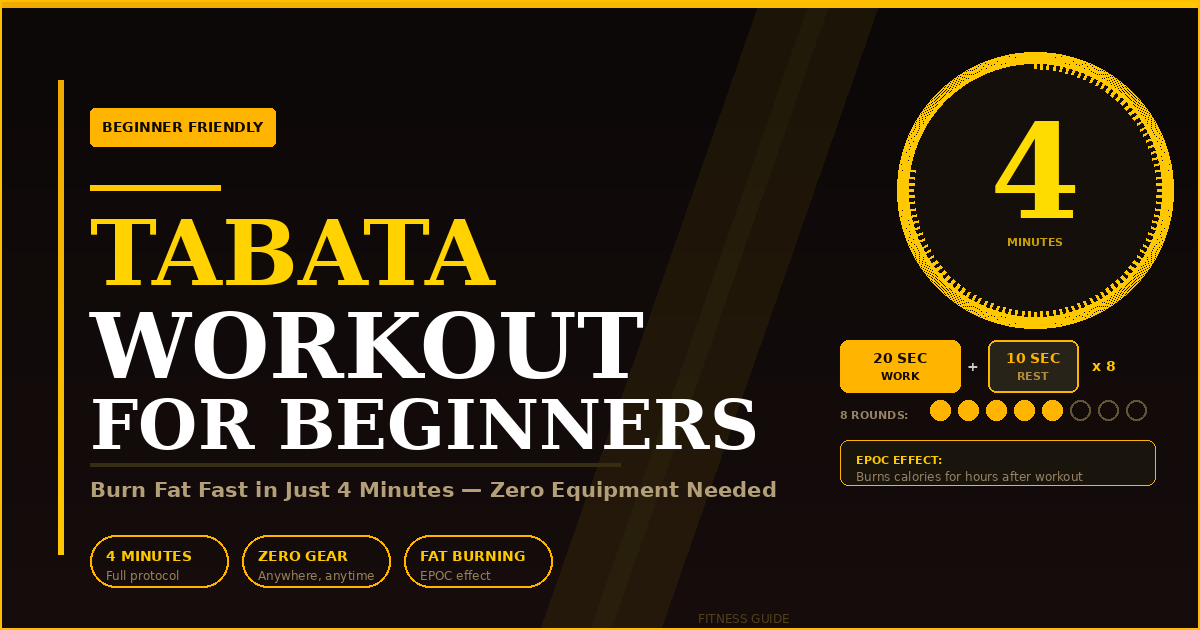
What if you could get a genuinely effective workout done in just 4 minutes? That’s exactly what the 4-minute Tabata workout for beginners delivers. No gym, no equipment, no long commitment — just 4 focused minutes that push your body harder than most 30-minute jogs ever could.
Tabata is not a trend. It’s a scientifically backed training protocol used by athletes, coaches, and everyday fitness enthusiasts worldwide. And the best part? It works just as well for complete beginners as it does for seasoned athletes — as long as you understand how it works and respect your limits.
This guide breaks down everything you need to know to start Tabata training today, safely and effectively.
What Is Tabata Training? (And Why It Works)
Tabata is a form of high-intensity interval training (HIIT) developed by Japanese scientist Dr. Izumi Tabata in 1996. His research found that short bursts of maximum-effort exercise, alternated with brief rest periods, produced greater improvements in both aerobic and anaerobic fitness than traditional steady-state cardio.
The structure is simple:
- 20 seconds of all-out effort
- 10 seconds of rest
- Repeat for 8 rounds
- Total time: 4 minutes
That’s it. Four minutes. But don’t let the brevity fool you — those 4 minutes are intense by design. The goal is to work at near-maximum capacity during each 20-second interval, which is what triggers the fat-burning and cardiovascular benefits.
The Science Behind the 20-10 Protocol
The 20-10 Tabata interval structure works because it keeps your heart rate elevated throughout the entire session. Unlike steady-state cardio where your body adapts quickly, the repeated short bursts prevent full recovery — which forces your cardiovascular system and muscles to work harder with each round.
This also triggers what’s known as EPOC — Excess Post-Exercise Oxygen Consumption. Essentially, your body continues burning calories at an elevated rate for hours after the workout ends. For a 4-minute session, that’s a remarkable return on investment.
Is Tabata Safe for Beginners?
Yes — with one important caveat: you must scale the intensity to your current fitness level.
Beginners often make the mistake of copying advanced Tabata videos and burning out after two rounds, or worse, risking injury by pushing too hard too soon. The good news is that Tabata is completely scalable. You control the effort level.
Here are a few beginner-friendly Tabata safety tips to follow from day one:
- Start with low-impact exercise variations (no jumping required)
- Focus on form during the 20-second work periods — speed comes later
- Use the 10-second rest fully — don’t rush into the next round
- If you can’t maintain form, slow down rather than stop
- Begin with 1–2 Tabata rounds per session and build up over 2–3 weeks
- Always include a proper warm-up before starting
Speaking of warm-ups — never skip them. Even for a 4-minute workout, a 3–5 minute Tabata warm-up prepares your joints, raises your heart rate gradually, and significantly reduces injury risk. Check out the essential Tabata warm-up exercises guide to learn exactly how to prepare your body.
Best Beginner Tabata Exercises (No Equipment Needed)
The most effective bodyweight Tabata exercises for beginners are movements that engage multiple muscle groups, are easy to learn, and can be modified based on fitness level.
Lower Body Options
1. Squat The most fundamental lower body exercise. Feet shoulder-width apart, lower until thighs are parallel to the floor, drive back up. High muscle activation, low injury risk, perfect for Tabata intervals.
2. Reverse Lunge Step one foot back and lower your back knee toward the floor. Alternate legs each rep. Gentler on the knees than forward lunges and excellent for building leg strength and balance.
3. Glute Bridge Lie on your back, feet flat, drive your hips toward the ceiling. Great for activating the glutes and hamstrings without any joint stress — ideal for those with knee sensitivities.
Upper Body Options
4. Push-Up (or Incline Push-Up) Standard push-ups or hands-elevated on a surface for beginners. Targets chest, shoulders, and triceps in every rep.
5. Tricep Dip Using a chair or couch edge. Bend elbows to lower your body and press back up. Excellent arm conditioning with zero equipment.
6. Superman Hold Lie face down and lift arms and legs simultaneously. Strengthens the upper back, rear deltoids, and spinal extensors — muscles most people neglect in beginner-friendly fitness routines.
Full Body Options
7. Mountain Climber From a high plank, drive alternating knees toward your chest in a running motion. This is one of the best quick fat-burning workouts available — it trains the core, shoulders, and cardiovascular system simultaneously.
8. Burpee (Modified) For beginners, remove the jump. Step back to a plank, do a push-up, step forward, and stand up. Still highly effective as a cardio and strength Tabata movement without the joint impact.
9. High Knees (Marching Variation) Drive alternating knees up toward hip height. For low-impact, slow the movement to a march rather than a run. Still elevates the heart rate significantly.
Complete 4-Minute Tabata Workout for Beginners
Here are two beginner Tabata routines — one full body and one lower body focused. Each follows the classic 20-seconds-on, 10-seconds-off format for 8 rounds.
Routine A: Full Body Beginner Tabata (Single Exercise)
Pick one exercise and perform it for all 8 rounds. This is the purest form of Tabata and ideal for your first few sessions.
Recommended exercise: Squat or Mountain Climber
| Round | Work | Rest |
| 1 | 20 sec — Max effort squats | 10 sec rest |
| 2 | 20 sec — Max effort squats | 10 sec rest |
| 3 | 20 sec — Max effort squats | 10 sec rest |
| 4 | 20 sec — Max effort squats | 10 sec rest |
| 5 | 20 sec — Max effort squats | 10 sec rest |
| 6 | 20 sec — Max effort squats | 10 sec rest |
| 7 | 20 sec — Max effort squats | 10 sec rest |
| 8 | 20 sec — Max effort squats | Done! |
Total time: 4 minutes
Routine B: Alternating Beginner Tabata (Two Exercises)
Slightly more advanced. Alternate between two exercises every round.
| Round | Exercise | Work | Rest |
| 1 | Squat | 20 sec | 10 sec |
| 2 | Push-Up | 20 sec | 10 sec |
| 3 | Squat | 20 sec | 10 sec |
| 4 | Push-Up | 20 sec | 10 sec |
| 5 | Squat | 20 sec | 10 sec |
| 6 | Push-Up | 20 sec | 10 sec |
| 7 | Squat | 20 sec | 10 sec |
| 8 | Push-Up | 20 sec | Done! |
Total time: 4 minutes
Both routines work beautifully as a no-equipment Tabata workout and can be done anywhere — your bedroom, garden, or hotel room.
Tabata vs HIIT: What’s the Difference?
Many beginners use these terms interchangeably, but they’re not the same thing.
| Factor | Tabata | General HIIT |
| Work interval | Fixed: 20 seconds | Varies (20–60 seconds) |
| Rest interval | Fixed: 10 seconds | Varies (10–60 seconds) |
| Session length | Exactly 4 minutes per round | Usually 15–30 minutes |
| Intensity required | Near-maximum | Moderate to high |
| Best for | Cardiovascular + anaerobic | General fitness + fat loss |
| Beginner-friendly | Yes (when scaled) | Yes |
Tabata is technically a subset of HIIT — but its fixed, compressed structure makes it uniquely demanding and time-efficient. For a deeper breakdown, explore the full Tabata or HIIT comparison guide.
How to Progress Your Tabata Training Over Time
One of the biggest advantages of Tabata for beginners is how naturally it scales with your fitness level. Here’s a simple progression roadmap:
Weeks 1–2: One Tabata round (4 minutes) per session. Focus entirely on form and completing all 8 intervals.
Weeks 3–4: Add a second Tabata round after a 1-minute rest. Introduce slightly more demanding exercises like mountain climbers or modified burpees.
Weeks 5–6: Three Tabata rounds with 60 seconds rest between each. Increase effort during work intervals — push closer to true maximum capacity.
Week 7+: Experiment with the morning Tabata routine format — completing your sessions first thing to boost energy and metabolism throughout the day. See the morning Tabata routine guide for tips on structuring early sessions.
Recovery After Tabata — Don’t Skip This
Because Tabata is high-intensity, recovery matters more than people realize. Even though sessions are short, the demand on your muscles and cardiovascular system is significant.
After every session:
- Spend 3–5 minutes doing light stretching or walking
- Rehydrate — you’ll sweat more than you expect in 4 minutes
- Eat a small protein-rich snack within 30–60 minutes if training fasted
- Allow at least one rest day between Tabata sessions when starting out
Good Tabata recovery tips also include foam rolling tight muscles, prioritizing sleep, and listening to your body. If you feel sharp joint pain during any exercise — stop immediately. Muscle fatigue is normal. Pain is not. For a complete recovery protocol, check out the Tabata recovery tips guide.
FAQ: 4-Minute Tabata Workout for Beginners
Q: Is 4 minutes of Tabata actually enough exercise? For cardiovascular fitness and fat burning, yes — especially for beginners. Research shows that high-intensity 4-minute Tabata sessions improve aerobic capacity significantly. Over time, you can add multiple rounds to increase volume, but one round done at full effort delivers real benefits.
Q: How many times per week should beginners do Tabata? Start with 2–3 sessions per week with rest days in between. As your fitness improves over 3–4 weeks, you can progress to 4 sessions per week. Tabata is demanding — more frequent sessions without adequate recovery can lead to burnout or injury.
Q: Can Tabata help with weight loss? Yes. The combination of intense caloric burn during the session and elevated metabolism post-workout (EPOC effect) makes Tabata highly effective for weight loss. Pairing it with a balanced diet accelerates results significantly.
Q: Do I need any equipment for beginner Tabata? No. The 4-minute Tabata workout for beginners requires zero equipment. All exercises in this guide use only your bodyweight. A timer or Tabata app is the only tool you need — and most smartphones have free options available.
Q: What’s the best Tabata app for beginners? Several free apps are excellent for beginners, including Tabata Timer, Interval Timer, and HIIT & Tabata Timer. They handle the 20-10 countdown automatically so you can focus entirely on the workout. Explore the best Tabata apps for beginners guide for a full comparison.
Q: Can I do Tabata if I have bad knees? Yes — with modifications. Replace jumping movements with low-impact alternatives like glute bridges, seated marching, or incline push-ups. Always consult a physiotherapist if you have existing joint issues before starting any new high-intensity training.
Q: How long before I see results from Tabata training? Most beginners notice improved cardiovascular endurance within 2–3 weeks. Visible body composition changes typically appear within 4–6 weeks when Tabata is combined with consistent nutrition habits.
Conclusion
The 4-minute Tabata workout for beginners is one of the most time-efficient, scientifically proven, and accessible fitness tools available today. It demands effort — but it rewards that effort with genuine results in cardiovascular fitness, fat loss, and overall conditioning.
Start with one round. Master the form. Progress through the beginner routines in this guide. And within a few weeks, you’ll be completing multiple rounds with confidence and feeling the difference in your energy, endurance, and body.
Four minutes. No excuses. Start today.