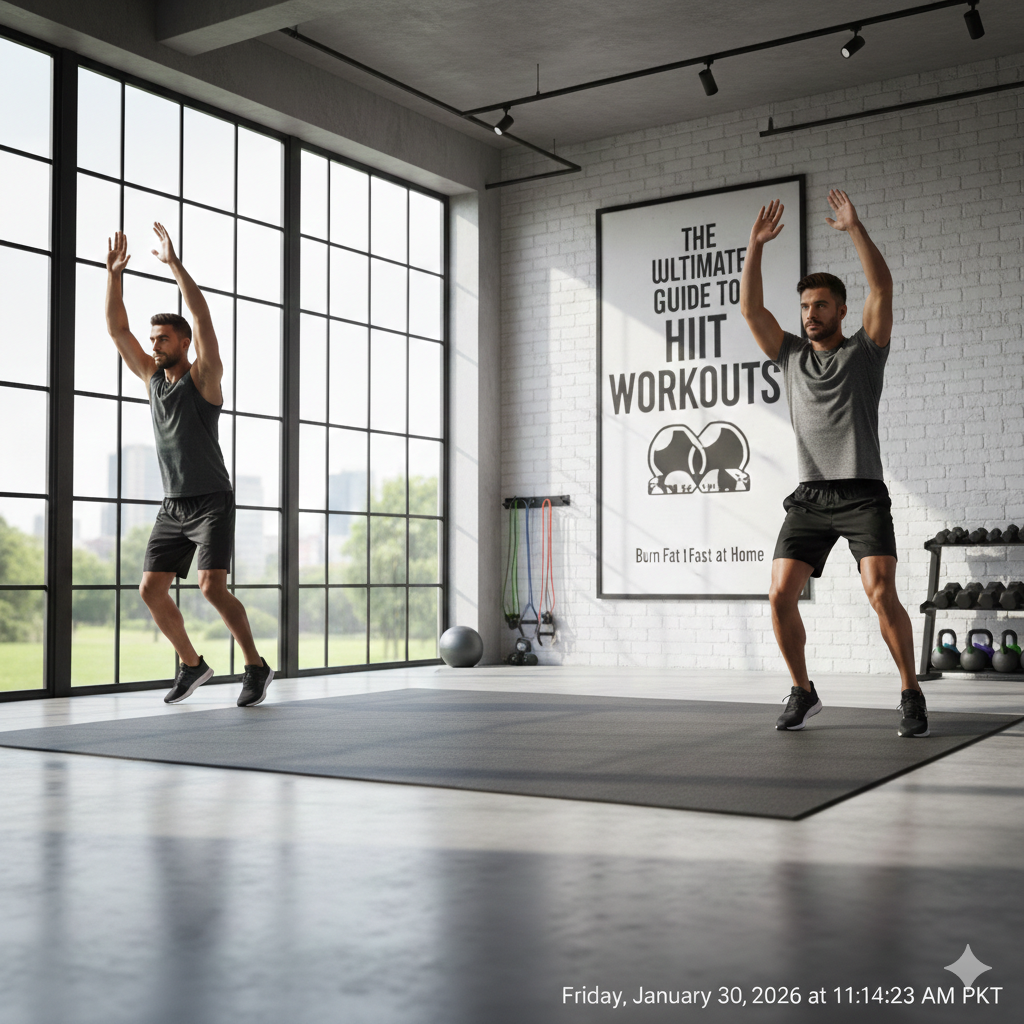
High-Intensity Interval Training (HIIT) has revolutionized the fitness world by offering maximum results in minimum time. If you’re looking to burn fat fast, improve your metabolic rate, and achieve your weight loss goals without spending hours at the gym, HIIT workouts at home might be your perfect solution. This comprehensive guide covers everything you need to know about HIIT, from beginner-friendly exercises to advanced workout plans.
What is HIIT and How Does It Burn Fat?
HIIT alternates between short bursts of intense exercise and brief recovery periods. This training method triggers excess post-exercise oxygen consumption (EPOC), also known as the “afterburn effect,” which means your body continues burning calories long after your workout ends. Unlike traditional steady-state cardio, HIIT keeps your metabolic rate elevated for up to 24 hours post-exercise.
The science behind HIIT’s effectiveness lies in its ability to push your body into the optimal heart rate fat-burning zone while simultaneously building muscle. This dual benefit makes HIIT superior to traditional cardio for fat loss, as muscle building and fat loss occur simultaneously, creating a leaner, more defined physique.
Does HIIT Burn Belly Fat?
One of the most common questions is: does HIIT burn belly fat? The answer is yes, but with an important caveat. While you cannot spot-reduce fat from specific areas, HIIT workouts are among the best exercises that burn the most calories, creating the calorie deficit necessary for overall fat loss, including stubborn belly fat. HIIT for belly fat works by increasing your overall caloric expenditure and improving insulin sensitivity, both crucial factors in reducing abdominal fat.
Research consistently shows that combining HIIT with proper nutrition and maintaining a calorie deficit leads to significant reductions in visceral fat, the dangerous fat surrounding your organs. This makes HIIT not just an aesthetic choice but a vital component of obesity prevention and exercise for heart health.
Best HIIT Exercises for Maximum Fat Loss
Jumping Jacks Exercise
Jumping jacks are a classic full-body movement that elevates your heart rate quickly. This exercise engages your legs, core, and shoulders while improving cardiovascular endurance. To perform jumping jacks correctly, stand with feet together and arms at your sides, then jump while simultaneously spreading your legs and raising your arms overhead. Return to the starting position and repeat rapidly for 30-60 seconds.
Burpees Workout
Burpees are often called the king of HIIT exercises because they work virtually every muscle group. This compound movement combines a squat, plank, push-up, and jump into one fluid motion. Start standing, drop into a squat with hands on the floor, kick your feet back into a plank position, perform a push-up, jump your feet back to your hands, and explosively jump upward. Burpees workout sessions torch calories like few other exercises can.
Mountain Climbers
Mountain climbers provide an intense cardiovascular challenge while strengthening your core, shoulders, and legs. Begin in a plank position with hands directly under shoulders. Drive one knee toward your chest, then quickly switch legs in a running motion while maintaining a strong plank position. The faster you move, the more calories you burn.
Squat Jumps Exercise
Squat jumps combine strength training and plyometric power to maximize calorie burn. Lower into a squat position with thighs parallel to the ground, then explosively jump upward, reaching your arms overhead. Land softly and immediately descend into the next squat. This exercise targets your glutes, quads, and hamstrings while elevating your heart rate significantly.
High Knees Exercise
High knees are excellent for building lower body strength and cardiovascular endurance. Run in place while driving your knees as high as possible toward your chest, pumping your arms vigorously. Maintain an upright posture and focus on speed to maximize calorie expenditure.
Push-Ups Workout
Push-ups build upper body and core strength while providing a metabolic boost when performed at high intensity. Keep your body in a straight line from head to heels, lower your chest to the floor, then push back up powerfully. Modify by dropping to your knees if needed, or increase intensity with plyometric variations.
Plank Jacks
Plank jacks combine core stability with cardiovascular training. Start in a plank position, then jump your feet wide apart and back together while maintaining a stable core and preventing your hips from bouncing. This exercise challenges your coordination while building core strength and burning calories.
Lunges Exercise
Lunges can be transformed into a HIIT exercise by performing jump lunges or alternating lunges at high speed. This movement targets your glutes, quads, and hamstrings while improving balance and coordination. Step forward into a lunge position, ensuring your front knee stays above your ankle, then push back to standing or jump to switch legs.
Skater Jumps
Skater jumps mimic the side-to-side motion of speed skating, providing a unique cardiovascular and lower body challenge. Leap laterally from one foot to the other, swinging your arms for momentum and balance. This exercise improves lateral movement patterns while torching calories.
Jump Rope for Weight Loss
Jump rope for weight loss is incredibly effective, burning approximately 10-16 calories per minute. This simple yet challenging exercise improves coordination, cardiovascular fitness, and bone density. Vary your jumping patterns with double-unders, single-leg hops, or high knees to keep workouts interesting.
Stair Climbing Workout
If you have access to stairs, stair climbing workout sessions provide an excellent HIIT option. Sprint up the stairs as quickly as possible, then walk down for recovery. This exercise builds powerful legs and glutes while providing serious cardiovascular benefits.
HIIT Workout Plans for Every Fitness Level
Low-Impact HIIT Workout for Beginners
For those new to exercise or dealing with joint issues, a low-impact HIIT workout provides all the benefits without the joint stress. Replace jumping movements with stepping variations, perform modified burpees without the jump, and use marching high knees instead of running. This fat-burning workout for beginners still elevates your heart rate without the pounding impact.
Sample 10-Minute HIIT Workout for Beginners:
- Marching in place with high knees: 30 seconds
- Rest: 30 seconds
- Modified burpees (no jump): 30 seconds
- Rest: 30 seconds
- Step-back lunges: 30 seconds
- Rest: 30 seconds
- Plank hold: 30 seconds
- Rest: 30 seconds
- Repeat circuit twice
20-Minute HIIT Workout for Intermediate Level
Once you’ve built a fitness foundation, a 20-minute HIIT workout provides substantial calorie burn and fitness improvements. This workout includes more complex movements and shorter rest periods.
Sample Intermediate Workout:
- Jumping jacks: 40 seconds, rest 20 seconds
- Burpees: 40 seconds, rest 20 seconds
- Mountain climbers: 40 seconds, rest 20 seconds
- Squat jumps: 40 seconds, rest 20 seconds
- Push-ups: 40 seconds, rest 20 seconds
- High knees: 40 seconds, rest 20 seconds
- Complete 3 rounds with 1-minute rest between rounds
Advanced HIIT Workout
An advanced HIIT workout pushes your limits with longer work intervals, shorter rest periods, and more challenging exercise variations. This level is appropriate for those with several months of consistent training.
Sample Advanced 30-Minute Workout:
- Burpees with push-up: 50 seconds, rest 10 seconds
- Jump lunges: 50 seconds, rest 10 seconds
- Plank jacks: 50 seconds, rest 10 seconds
- Double-unders or high-speed jump rope: 50 seconds, rest 10 seconds
- Skater jumps: 50 seconds, rest 10 seconds
- Mountain climbers: 50 seconds, rest 10 seconds
- Complete 5 rounds
HIIT Workout Without Equipment
One of HIIT’s greatest advantages is that you can perform an effective HIIT workout without equipment. Bodyweight exercises like those listed above provide all the resistance and intensity needed for maximum fat burning. This makes HIIT perfect as the best workout to lose weight at home, requiring only your body and determination.
How Often to Do HIIT: Finding the Right Balance
A critical question for anyone starting HIIT is: how often to do HIIT? The intensity of HIIT means recovery is essential. For most people, 2-4 HIIT sessions per week is optimal, allowing at least 48 hours between sessions for muscle recovery. Overtraining can lead to injury, hormonal imbalances, and decreased performance.
How Much HIIT is Too Much?
How much HIIT is too much depends on individual factors like fitness level, nutrition, sleep quality, and life stress. Warning signs of overtraining include persistent fatigue, decreased performance, increased resting heart rate, irritability, and frequent illness. If you experience these symptoms, reduce training frequency and ensure adequate recovery through proper nutrition and sleep.
Strength Training vs Cardio for Fat Loss
The debate of strength training vs cardio for fat loss often creates confusion. The truth is that combining both yields superior results. HIIT provides the cardiovascular benefits and calorie burn of cardio while incorporating strength-building movements. This combination increases lean muscle mass, which elevates your resting metabolic rate, meaning you burn more calories even at rest.
Pure cardio burns calories during the activity but provides minimal metabolic boost afterward. Strength training builds muscle that continuously burns calories. HIIT bridges these benefits, providing both immediate calorie burn and long-term metabolic improvements through muscle building and fat loss occurring simultaneously.
Best Cardio for Weight Loss
When comparing different forms of cardio, HIIT consistently ranks as the best cardio for weight loss due to its time efficiency and EPOC effect. However, the truly best cardio is the one you’ll do consistently. Some people prefer the meditative nature of steady-state running, while others thrive on HIIT’s intensity and variety.
Creating Your HIIT Workout Plan
A well-structured HIIT workout plan balances intensity with recovery and progressively increases difficulty. Here’s how to create an effective plan:
- Start with assessment: Determine your current fitness level honestly
- Choose appropriate exercises: Select movements you can perform with proper form
- Establish work-to-rest ratios: Beginners use 1:2 (30 seconds work, 60 seconds rest), intermediate 1:1, advanced 2:1
- Plan frequency: Schedule 2-4 sessions weekly with rest days between
- Track progress: Monitor performance improvements and adjust accordingly
- Include variety: Rotate exercises to prevent boredom and overuse injuries
Nutrition Essentials: Creating a Calorie Deficit
No discussion of how to lose weight with exercise is complete without addressing nutrition. Exercise alone rarely creates sufficient calorie deficit for significant fat loss. To maximize results, combine HIIT with appropriate nutrition that creates a moderate calorie deficit of 300-500 calories daily.
Focus on whole foods, adequate protein (0.8-1 gram per pound of body weight), complex carbohydrates for energy, and healthy fats. Avoid extreme restriction, which can backfire by slowing metabolic rate and increasing hunger hormones. Sustainable fat loss requires patience and consistency rather than drastic measures.
Monitoring Your Heart Rate Fat-Burning Zone
Understanding your heart rate fat-burning zone helps optimize workout intensity. Calculate your maximum heart rate by subtracting your age from 220. During HIIT, aim for 80-95% of maximum heart rate during work intervals, dropping to 60-70% during recovery. This ensures you’re working hard enough to trigger the metabolic benefits without overtraining.
Many fitness trackers provide real-time heart rate monitoring, making it easy to stay in your target zones. However, perceived exertion is also valuable—you should be breathing too hard to maintain a conversation during work intervals but able to speak in short phrases during recovery.
Health Benefits Beyond Fat Loss
While fat loss motivates many people to try HIIT, the health benefits extend far beyond aesthetics. Regular HIIT training improves cardiovascular health by strengthening your heart and improving blood pressure. It enhances insulin sensitivity, reducing diabetes risk, and serves as powerful obesity prevention. HIIT also improves mental health by releasing endorphins and reducing stress hormones.
Getting Started Today
The beauty of HIIT is its accessibility. You don’t need a gym membership, expensive equipment, or hours of free time. Starting with just a 10-minute HIIT workout three times weekly can produce noticeable improvements in fitness and body composition within weeks. As you progress, gradually increase workout duration, intensity, and frequency while listening to your body’s recovery needs.
Remember that consistency trumps perfection. Some movement is always better than none, and the best workout is the one you’ll actually do. Whether you choose a low-impact HIIT workout to protect your joints or an advanced HIIT workout to push your limits, the key is starting and maintaining regular practice.
By incorporating these exercises, following appropriate workout plans for your fitness level, and supporting your efforts with proper nutrition to maintain a calorie deficit, you’ll harness HIIT’s powerful fat-burning potential while building a stronger, healthier body. The combination of elevated metabolic rate, excess post-exercise oxygen consumption, and muscle building makes HIIT one of the most effective approaches to how to burn fat fast and achieve lasting fitness results.