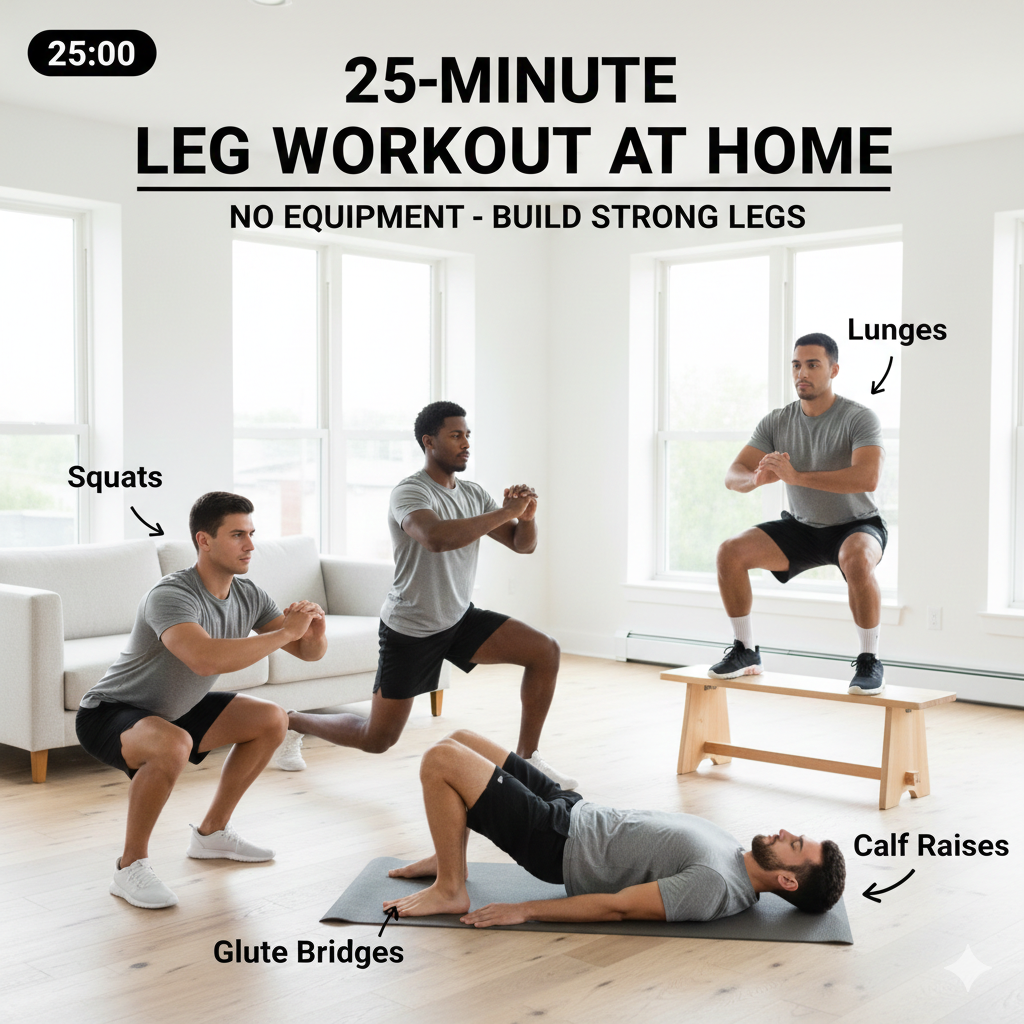
You don’t need a gym membership or fancy equipment to build strong, toned legs. Whether you’re short on time, working out in a small apartment, or just prefer exercising at home, a leg workout at home no equipment can deliver incredible results. In fact, bodyweight exercises engage multiple muscle groups simultaneously, improve functional strength, and can be just as effective as weighted workouts when done correctly.
In this comprehensive guide, you’ll discover a complete lower body workout routine that takes just 25 minutes, requires zero equipment, and works for all fitness levels. From beginners taking their first steps into fitness to experienced athletes looking for a convenient home routine, this workout plan has you covered.
Why Bodyweight Leg Workouts Are Highly Effective
Many people wonder: can you really build leg muscles at home without weights? The answer is absolutely yes. Bodyweight leg exercises utilize your own weight as resistance, which is often more than enough to challenge your muscles, especially when you focus on proper form and progressive overload.
Benefits of at home leg workout routines include:
- No cost or equipment needed
- Flexibility to train anywhere, anytime
- Lower injury risk compared to heavy weights
- Improved balance and coordination
- Functional strength that translates to daily activities
- Apartment-friendly options with no jumping required
- Time-efficient workouts that fit busy schedules
Research shows that bodyweight training can significantly increase muscle strength and endurance. The key lies in consistency, proper technique, and gradually increasing difficulty through variations and tempo changes.
Understanding Your Lower Body Muscles
Before diving into the workout, it’s helpful to understand which muscles you’ll be targeting. Your legs contain some of the largest and most powerful muscle groups in your body.
Primary muscle groups worked in a complete leg workout at home:
- Quadriceps: Front thigh muscles responsible for knee extension
- Hamstrings: Back of thigh muscles that flex the knee and extend the hip
- Glutes: Your buttocks muscles, crucial for hip extension and stability
- Calves: Lower leg muscles that control ankle movement
- Hip flexors: Muscles that lift your knee and stabilize your core
A well-rounded home leg workout routine should target all these areas for balanced strength development and injury prevention.
The 25-Minute No Equipment Leg Workout Routine
This leg workout plan at home is structured to maximize results in minimal time. You’ll perform each exercise for 45 seconds, followed by 15 seconds of rest. Complete the entire circuit three times with a 60-second break between rounds.
Warm-Up (5 Minutes)
Never skip your warm-up. Preparing your muscles and joints prevents injury and improves performance.
- Marching in place – 1 minute
- Leg swings (forward and sideways) – 1 minute each leg
- Bodyweight squats – 1 minute (slow and controlled)
- Walking lunges – 1 minute
Main Workout Circuit (15 Minutes)
Exercise 1: Squats
The foundation of any leg workout at home for beginners, squats target your quads, glutes, and hamstrings simultaneously. Stand with feet shoulder-width apart, lower your hips back and down as if sitting in a chair, keeping your chest up and knees tracking over your toes. Push through your heels to return to standing.
Exercise 2: Reverse Lunges
Step backward with one leg, lowering your back knee toward the ground while keeping your front shin vertical. This beginner-friendly variation is easier on the knees than forward lunges. Alternate legs throughout the 45-second interval.
Exercise 3: Glute Bridges
Lie on your back with knees bent and feet flat on the floor. Lift your hips toward the ceiling, squeezing your glutes at the top. This effective leg exercise at home specifically targets your glutes and hamstrings while being gentle on your lower back.
Exercise 4: Bulgarian Split Squats (Bodyweight)
Find a low chair or couch. Place one foot behind you on the elevated surface and lower into a lunge position. This advanced movement intensely works each leg individually, improving balance and addressing muscle imbalances.
Exercise 5: Calf Raises
Stand tall and rise onto your toes, squeezing your calf muscles at the top. Lower with control. For added difficulty, perform these on a step with your heels dropping below the level of your toes.
Exercise 6: Side Lunges
Step wide to one side, bending that knee while keeping the other leg straight. This lateral movement targets your inner and outer thighs, areas often neglected in traditional leg workouts.
Cool-Down and Stretching (5 Minutes)
Finish your bodyweight leg workout at home with these essential stretches, holding each for 30-60 seconds:
- Quad stretch (standing or lying)
- Hamstring stretch (seated or standing)
- Figure-four glute stretch
- Calf stretch against wall
- Hip flexor stretch (low lunge position)
How to Progress Your Home Leg Workout
One common question is: how long should a leg workout be at home to see results? While this 25-minute routine is highly effective, progression matters more than duration.
Ways to advance your no equipment leg workout plan:
- Increase time under tension by slowing down each repetition
- Add isometric holds at the most challenging position
- Perform additional rounds of the circuit
- Reduce rest periods between exercises
- Try single-leg variations (pistol squats, single-leg deadlifts)
- Incorporate plyometric movements like jump squats (if appropriate for your space)
- Focus on explosive upward movements with controlled lowering
Remember, is bodyweight leg workout effective? Yes, but only if you continue challenging yourself as you get stronger.
Beginner Modifications and Safety Tips
If you’re new to fitness, this at home leg workout for beginners can be modified to match your current fitness level.
Beginner-friendly adjustments:
- Reduce work intervals to 30 seconds with 30-second rests
- Complete only one or two rounds instead of three
- Use a chair or wall for balance during lunges and squats
- Decrease your range of motion until flexibility improves
- Skip Bulgarian split squats and double up on regular squats or lunges
Safety considerations for your leg workout at home:
- Always prioritize form over speed or repetitions
- Stop immediately if you experience sharp pain (muscle burn is normal, joint pain is not)
- Maintain proper alignment: knees tracking over toes, neutral spine
- Breathe consistently throughout each movement
- Stay hydrated before, during, and after your workout
- Allow at least one rest day between intense leg sessions for muscle recovery
Creating Your Weekly Leg Workout Schedule
How often should I do leg workout at home? For most people, training legs 2-3 times per week provides optimal results while allowing adequate recovery.
Sample weekly schedule:
- Monday: Full leg workout (this 25-minute routine)
- Tuesday: Upper body or core workout
- Wednesday: Active recovery (walking, yoga, stretching)
- Thursday: Full leg workout
- Friday: Upper body or cardio
- Saturday: Full leg workout or outdoor activity
- Sunday: Complete rest or gentle stretching
This approach gives you consistent stimulus for leg muscle growth while preventing overtraining. You can adjust frequency based on your recovery capacity and fitness goals.
Common Mistakes to Avoid
Even experienced exercisers sometimes make these errors during their lower body workout at home no equipment sessions:
Letting knees cave inward during squats: Keep your knees aligned with your toes throughout the movement. This protects your knee joints and ensures proper muscle activation.
Rising onto toes during lunges: Keep your weight distributed through your entire foot, particularly pressing through your heel for better glute engagement.
Rushing through repetitions: Quality beats quantity. Controlled movements with proper form deliver better results than sloppy, fast reps.
Neglecting the eccentric phase: The lowering portion of each exercise is just as important as the lifting phase. Take 2-3 seconds to lower yourself.
Ignoring muscle imbalances: If one leg feels significantly weaker, spend extra time on single-leg exercises to address the difference.
Nutrition Tips for Leg Muscle Growth
Exercise is only half the equation. To maximize results from your leg workout for strength, proper nutrition is essential.
Key nutritional strategies:
- Consume adequate protein (0.7-1 gram per pound of body weight daily) to support muscle repair
- Eat a balanced meal with carbohydrates and protein within 2 hours post-workout
- Stay properly hydrated throughout the day
- Don’t drastically cut calories while trying to build muscle
- Include anti-inflammatory foods like berries, leafy greens, and fatty fish
Remember, you can’t out-exercise a poor diet. Consistency with both training and nutrition yields the best transformation results.
Apartment-Friendly and Low-Impact Variations
Living in an apartment or needing a quiet leg workout at home doesn’t mean sacrificing effectiveness. Many leg exercises can be modified to reduce noise while maintaining intensity.
Quiet alternatives for apartment living:
- Replace jump squats with slow tempo squats with a 3-second hold at the bottom
- Substitute step-ups on a low platform instead of jumping movements
- Perform glute bridge pulses instead of explosive hip thrusts
- Try wall sits for an isometric quad burner
- Use pulsing lunges instead of jumping lunges
These low impact leg workout at home options are also excellent for those with joint concerns or recovering from minor injuries.
Tracking Your Progress
Monitoring improvements keeps you motivated and helps you make informed adjustments to your routine.
Effective ways to track progress:
- Keep a workout journal noting exercises, sets, and how you felt
- Take progress photos every 2-4 weeks (same time of day, same lighting)
- Record how many quality repetitions you can perform
- Note improvements in daily activities (climbing stairs, carrying groceries)
- Track measurements of thighs, hips, and calves monthly
- Monitor how quickly you recover between workouts
Progress isn’t always linear, but consistency over weeks and months will show clear improvements in strength, endurance, and muscle definition.
Frequently Asked Questions
Can you build leg muscles at home without equipment?
Yes, absolutely. Bodyweight exercises provide sufficient resistance for most people, especially beginners and intermediate exercisers. Progressive overload through increased repetitions, slower tempo, and advanced variations ensures continued muscle development. Many athletes maintain impressive leg strength using only bodyweight training.
How often should I do leg workout at home?
Most people benefit from training legs 2-3 times per week. This frequency allows for adequate stimulus while providing recovery time. Beginners might start with twice weekly, while more advanced individuals can handle three sessions. Always listen to your body and allow at least 48 hours between intense leg workouts.
Is bodyweight leg workout effective for toning?
Yes, bodyweight leg workouts are highly effective for toning and strengthening. “Toning” refers to building muscle while reducing body fat, which requires consistent exercise and proper nutrition. This workout routine targets all major leg muscles, and when combined with a balanced diet, will create defined, strong legs.
What are the best leg exercises for home workout?
The most effective exercises for a complete leg workout at home include squats, lunges (all variations), glute bridges, Bulgarian split squats, calf raises, and wall sits. These movements target all major muscle groups, require no equipment, and can be modified for any fitness level.
How long should a leg workout be at home to see results?
A 20-30 minute focused session is sufficient for most people. This 25-minute routine, when performed consistently 2-3 times weekly, will show noticeable results within 4-6 weeks. Quality and consistency matter more than duration. Even a quick 15-minute leg workout regularly beats occasional hour-long sessions.
Can I do leg workouts every day?
It’s not recommended to perform intense leg workouts daily. Muscles grow during recovery, not during the workout itself. Daily training can lead to overtraining, increased injury risk, and diminished results. Instead, aim for 2-3 dedicated leg days weekly with lighter activities like walking or stretching on other days.
What’s the difference between a leg workout at home for beginners female vs. male?
The fundamental exercises and principles are the same regardless of gender. However, women often prioritize glute development and may spend more time on exercises like glute bridges and hip thrusts, while men might focus more on overall leg mass. The key is choosing exercises that align with your personal goals, not your gender.
Conclusion: Your Journey to Stronger Legs Starts Now
Building strong, toned legs doesn’t require a gym membership, expensive equipment, or hours of free time. This leg workout at home no equipment routine proves that 25 minutes of focused, bodyweight training can deliver exceptional results when performed consistently.
The key to success lies in maintaining proper form, progressively challenging yourself, and staying patient with the process. Whether you’re a complete beginner starting your fitness journey or an experienced athlete looking for a convenient home routine, these exercises provide a solid foundation for lower body strength.
Start with the beginner modifications if needed, focus on mastering the movement patterns, and gradually increase intensity as you grow stronger. Combine this workout with adequate protein intake, proper hydration, and sufficient rest for optimal muscle development.
Remember, the best workout is the one you’ll actually do consistently. This time-efficient, effective leg workout eliminates every excuse standing between you and your fitness goals. Your journey to stronger, more defined legs begins today—no gym required. Ready to get started? Clear some space, set a timer, and commit to this routine 2-3 times this week. Your legs will thank you, and you’ll be amazed at how quickly you notice improvements in strength, endurance, and muscle definition. The power to transform your lower body is literally at your feet.