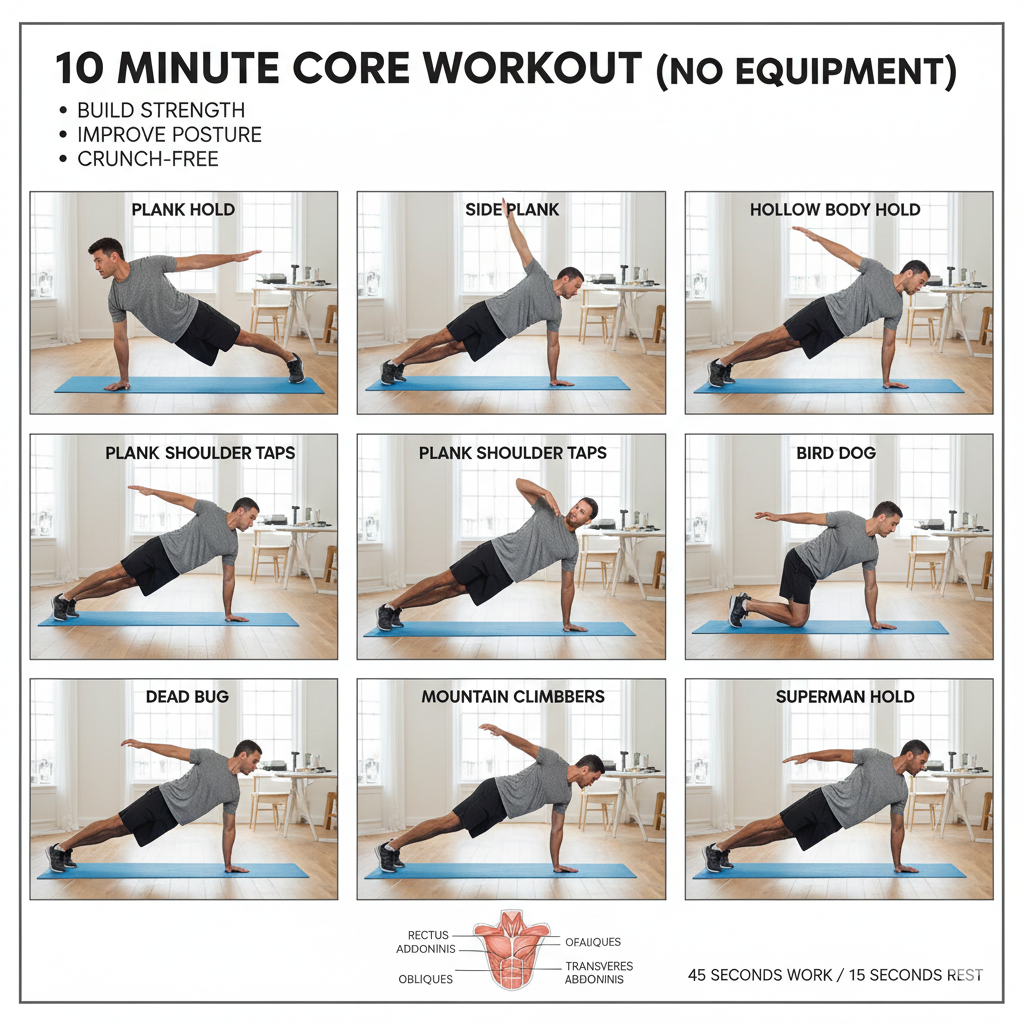
Are you tired of endless crunches that strain your neck and back? What if I told you that you could build a rock-solid core in just 10 minutes, right in your living room, without a single piece of equipment?
A 10 minute core workout no equipment routine is the perfect solution for busy professionals, parents, and fitness enthusiasts who want effective results without the gym membership or fancy gear. In this comprehensive guide, you’ll discover how to strengthen your entire core using functional, crunch-free exercises that protect your spine while delivering real results. Whether you’re a complete beginner or looking to add variety to your fitness routine, this article will equip you with everything you need to transform your midsection in less time than it takes to watch your favorite sitcom.
Why a 10 Minute Core Workout Works Better Than You Think
The beauty of short, focused core training lies in intensity and consistency rather than duration. Research shows that high-quality movement performed with proper form activates muscle fibers more effectively than lengthy, unfocused sessions.
When you commit to just 10 minutes daily, you’re more likely to maintain consistency—the true secret to building core strength. Your abdominal muscles, obliques, and deep stabilizers respond exceptionally well to frequent stimulation, making daily short workouts more effective than sporadic hour-long sessions.
The Science Behind Equipment-Free Core Training
Your core muscles don’t need weights or machines to grow stronger. In fact, bodyweight exercises often provide superior functional strength because they require:
- Multi-muscle engagement – Unlike isolation machines, bodyweight moves activate stabilizer muscles
- Natural movement patterns – Exercises that mimic real-life activities improve everyday function
- Progressive difficulty – Simply adjusting your body position changes resistance levels
- Lower injury risk – No external loads mean less joint stress
The Complete 10 Minute Core Workout Routine
This efficient routine targets all core muscle groups: rectus abdominis, transverse abdominis, internal and external obliques, and lower back muscles. Perform each exercise for 45 seconds with 15 seconds of rest between moves.
Plank Hold (45 seconds)
Start with the foundational plank to activate your entire core. Position your forearms on the ground, elbows directly under shoulders, and extend your legs behind you. Keep your body in a straight line from head to heels.
Form tips:
- Engage your glutes and quads to prevent hip sagging
- Pull your belly button toward your spine
- Look slightly ahead of your hands to maintain neutral neck position
- Breathe steadily throughout the hold
Side Plank (Right Side – 45 seconds)
Transition to your right forearm, stacking your feet or staggering them for more stability. Lift your hips to create a straight line from head to feet.
Key points:
- Keep your top shoulder pulled back
- Engage your obliques to maintain hip height
- Place your top hand on your hip or extend it toward the ceiling
- Modify by dropping your bottom knee to the ground
Side Plank (Left Side – 45 seconds)
Repeat the same movement on your left side, ensuring equal work for both sides of your body.
Hollow Body Hold (45 seconds)
Lie on your back and simultaneously lift your shoulders and legs off the ground, creating a “hollow” shape. Extend your arms overhead or alongside your body.
Execution guidelines:
- Press your lower back firmly into the floor
- Keep your core tight to prevent arching
- The lower you hold your legs, the harder it becomes
- Bend your knees if maintaining form becomes difficult
Plank Shoulder Taps (45 seconds)
Return to a high plank position (hands, not forearms). Alternately tap each shoulder with the opposite hand while minimizing hip rotation.
Performance cues:
- Widen your stance for more stability
- Move slowly and deliberately
- Keep your hips square to the floor
- Engage your core to prevent twisting
Bicycle Crunches (45 seconds)
While this list focuses on crunch-free options, bicycle crunches done correctly provide oblique activation with minimal neck strain. Lie on your back, lift your shoulders slightly, and rotate your torso to bring opposite elbow toward opposite knee.
Proper technique:
- Focus on rotation, not pulling your head
- Keep movements controlled rather than rushed
- Fully extend the non-working leg
- Breathe rhythmically with each rotation
Bird Dog (45 seconds – alternating sides)
Start on hands and knees. Extend your right arm forward and left leg backward simultaneously, then switch sides. This exercise brilliantly combines core stability with balance.
Execution essentials:
- Keep your extended limbs parallel to the floor
- Avoid twisting your hips or shoulders
- Pull your navel toward your spine throughout
- Move with control during transitions
Dead Bug (45 seconds)
Lie on your back with arms extended toward the ceiling and knees bent at 90 degrees. Lower opposite arm and leg toward the floor while keeping your back pressed down.
Critical details:
- Your lower back should never arch off the floor
- Move slowly to maximize time under tension
- Exhale as you extend, inhale as you return
- Keep your core braced throughout
Mountain Climbers (45 seconds)
From a high plank position, drive your knees alternately toward your chest in a running motion. This dynamic exercise elevates your heart rate while working your core.
Form requirements:
- Maintain a strong plank position throughout
- Keep your hips level—avoid bouncing
- Land softly on the balls of your feet
- Increase speed only when you can maintain form
Superman Hold (45 seconds)
Finish face-down with arms extended overhead. Simultaneously lift your arms, chest, and legs off the ground, engaging your entire posterior chain.
Important notes:
- Squeeze your glutes and lower back muscles
- Look down slightly to protect your neck
- Hold the top position or pulse gently
- This strengthens often-neglected lower back muscles
How to Maximize Results from Your Core Workout
Consistency Trumps Intensity
Training your core 5-6 times per week with this 10-minute routine produces better results than sporadic intense sessions. Schedule your workout at the same time daily to build a lasting habit.
Focus on Quality Over Speed
Every repetition should be performed with intention. Rushed movements reduce muscle activation and increase injury risk. If you’re struggling to maintain form, modify the exercise or take an extra rest break.
Progressive Overload Without Equipment
As exercises become easier, increase difficulty by:
- Holding positions longer (60-90 seconds instead of 45)
- Minimizing rest periods (10 seconds instead of 15)
- Adding pulses or movement variations
- Slowing down your tempo during dynamic exercises
- Combining exercises into supersets
Pair with Proper Nutrition
A strong core needs adequate protein for muscle repair and a balanced diet to reduce body fat. No amount of exercise will reveal defined abs if they’re covered by excess fat. Focus on whole foods, lean proteins, vegetables, and healthy fats.
Common Mistakes to Avoid
Holding Your Breath
Proper breathing is essential for core engagement. Exhale during the exertion phase and inhale during the release. Holding your breath increases blood pressure and reduces performance.
Neglecting Your Lower Back
Many people focus exclusively on their “six-pack” muscles while ignoring the lower back. A balanced core workout, like the one outlined above, prevents muscle imbalances and reduces injury risk.
Incorrect Plank Form
The most common mistake is allowing your hips to sag. This shifts the work from your core to your lower back, potentially causing pain. Film yourself or use a mirror to check your alignment.
Skipping the Warm-Up
While 10 minutes seems short, spending 60-90 seconds on light movement (jumping jacks, arm circles, torso twists) prepares your muscles and reduces injury risk.
Adapting the Workout for Different Fitness Levels
Beginner Modifications
- Perform planks on your knees instead of toes
- Hold positions for 20-30 seconds instead of 45
- Take 20-30 seconds of rest between exercises
- Reduce mountain climber speed to a controlled march
- Use a wall for support during balance exercises
Advanced Progressions
- Add single-leg variations to planks and holds
- Incorporate explosive movements (plank jacks, burpees)
- Extend work intervals to 60 seconds
- Eliminate rest periods completely
- Perform the circuit twice for a 20-minute workout
Modifications for Pregnancy or Postpartum
Always consult your healthcare provider first, but generally:
- Avoid exercises lying flat on your back after the first trimester
- Modify planks to an incline position (hands on a bench)
- Focus on breathing and pelvic floor engagement
- Avoid exercises that create “coning” in your abdomen
- Listen to your body and stop if anything feels wrong
The Mind-Muscle Connection
Simply going through the motions won’t deliver optimal results. Actively think about the muscles you’re working during each exercise. This neurological connection, called the mind-muscle link, significantly improves muscle activation and development.
During a plank, don’t just hold the position—consciously squeeze your abs, engage your glutes, and activate your quads. This intentional focus transforms a passive hold into an active strengthening exercise.
Tracking Your Progress
Document your journey to stay motivated and identify improvements:
- Week 1-2: Focus on learning proper form; don’t worry about difficulty
- Week 3-4: Notice improved endurance; exercises feel slightly easier
- Week 5-6: Visible improvements in posture and reduced lower back discomfort
- Week 7-8: Clothes fit better; core feels noticeably stronger
- Week 9-12: Advanced variations become accessible; visible muscle definition
Take photos, measurements, or simply note how exercises feel. Progress isn’t always visible immediately, but functional improvements come quickly.
Frequently Asked Questions
Q: Can I really get a strong core in just 10 minutes per day?
A: Absolutely. When you perform focused, high-quality exercises with proper form, 10 minutes provides sufficient stimulus for core development. The key is consistency and progressive overload. Many people see noticeable strength improvements within 3-4 weeks.
Q: How soon will I see visible abs from this workout?
A: Visible abs depend primarily on body fat percentage rather than core strength alone. You’ll build stronger abdominal muscles within weeks, but seeing definition requires reducing body fat through proper nutrition and overall caloric balance. Most people need to reach 10-15% body fat (men) or 18-22% (women) for visible abs.
Q: Should I do this workout every day or take rest days?
A: Core muscles recover relatively quickly compared to larger muscle groups. You can safely perform this routine 5-6 days per week. However, if you experience unusual soreness or fatigue, take an extra rest day. Listen to your body’s signals.
Q: Can this workout replace gym-based ab training?
A: For most people, yes. This routine provides comprehensive core strengthening without equipment. However, if you’re an athlete requiring sport-specific training or advanced strength development, you might eventually want to incorporate weighted exercises.
Q: What’s the best time of day to do this core workout?
A: The best time is whenever you’ll actually do it consistently. Many people prefer mornings to energize their day and ensure they complete the workout before other obligations arise. Others prefer evenings to relieve stress. Experiment to find what works for your schedule and energy levels.
Q: I have lower back pain. Is this workout safe for me?
A: Many people with lower back pain actually benefit from proper core strengthening, as it supports the spine. However, always consult a healthcare provider before starting any exercise program with existing pain. Modify exercises as needed and stop immediately if pain increases.
Q: Do I need a yoga mat for these exercises?
A: While not absolutely necessary, a mat provides cushioning for your elbows, knees, and spine, making exercises more comfortable. A towel on carpet can work as an alternative, though it provides less padding than a proper exercise mat.
Conclusion: Your Path to a Stronger Core Starts Now
Building a powerful, functional core doesn’t require expensive equipment, gym memberships, or hours of your day. This 10 minute core workout no equipment routine delivers real results through efficient, science-backed exercises that you can perform anywhere, anytime.
The key to success lies not in perfection but in consistency. Start today, commit to the process, and trust that small daily efforts compound into significant transformation. Your core muscles will grow stronger, your posture will improve, and everyday movements will become easier.
Remember that core strength extends beyond aesthetics—it’s about creating a stable foundation for all movement, reducing injury risk, and improving your overall quality of life. Whether you’re working toward visible abs, better athletic performance, or simply wanting to move through life with less back pain, this 10-minute routine provides the foundation you need. Set aside just 10 minutes today. Roll out your mat, review the exercises, and complete your first session. Your stronger, more capable core is waiting just 10 minutes away.